
English
Norman Rockwell
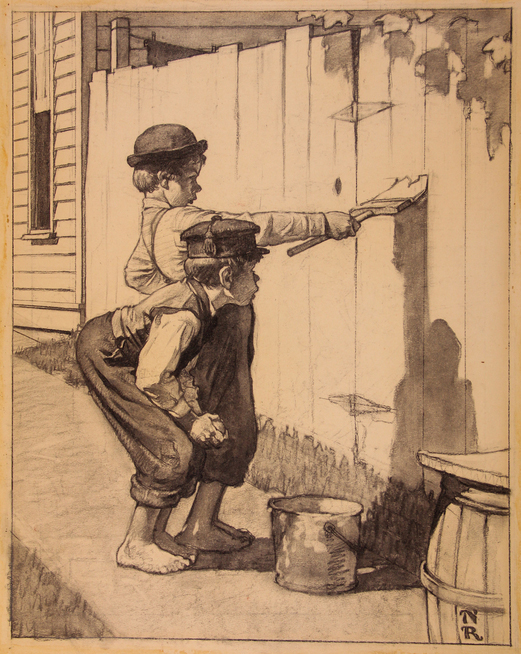
Tom Sawyer Whitewashing the Fence – Norman Rockwell, c. 1936
Story illustration for The Adventures of Tom Sawyer by Mark Twain (1936)
Oil on canvas
[NARRATOR] In 1935, Rockwell was commissioned to illustrate new editions of Mark Twain’s classics, “Tom Sawyer” and “Huckleberry Finn.” In this scene, Tom whitewashes a fence. He’s enticing his friend to take over this dreaded chore by pretending it’s the most fascinating thing he’s ever done.
Look closely at the brushwork on the fence. The visible strokes mirror the amateur paint job of the characters in the story.
[KNUTSON] He’s weaving the whole technique that he uses in this painting … into the subject matter of the painting, which is about–painting! (laughs) So it’s … very modern in that sense. And you know, most people say–Oh there is nothing modern about Rockwell’s painting!
Rockwell traveled to Hannibal, Missouri, Twain’s hometown, to scout locations and find authentic clothes for his models. He bought hats and shirts directly from people he saw walking on the street, even exchanging his own clothing with a man wearing the perfect, tattered outfit.
Family
Norman Rockwell
Tom Sawyer Whitewashing the Fence – Norman Rockwell, c. 1936
Story illustration for The Adventures of Tom Sawyer by Mark Twain (1936)
Oil on canvas
[NARRATOR] This is a scene from the book, “Tom Sawyer,” by Mark Twain.
[MARK TWAIN VOICE] Tom appeared on the sidewalk with a bucket of whitewash and a long-handled brush. He surveyed the fence, and all gladness left him.
[NARRATOR] If you haven’t already read the book–here’s what’s going on: Tom has to whitewash– or paint– the fence around his house, and he really really doesn’t want to do it. His friend Ben walks by, and Tom pretends he’s having too much fun doing his chore to go play.
[TOM SAWYER VOICE] Well, I don’t see why I oughtn’t to like it. Does a boy get a chance to whitewash a fence every day?”
[MARK TWAIN VOICE] That put the thing in a new light. Ben stopped nibbling his apple. Tom swept his brush daintily back and forth — stepped back to note the effect — added a touch here and there — criticized the effect again — Ben watching every move and getting more and more interested, more and more absorbed. Presently he said:
[BEN VOICE] “Say, Tom, let me whitewash a little.”
[NARRATOR] So–Tom gets all his friends to do his chore for him!
Now, I try never to fake anything in a picture like this. I went all the way to Hannibal, Missouri–Mark Twain’s hometown, on the banks of the Mississippi River–to find the right clothes for all the characters to wear. I bought the perfect worn-out hat right off of one man’s head.
Spanish
Norman Rockwell
c. 1914
Story illustration for Boys’ Life (1914)
Oil on canvas
Peter Rockwell: En 1914, cuando mi padre solo tenía 20 años de edad, pintó esta imagen de Daniel Boone. En esta obra podemos ver al famoso cazador y colonizador estadounidense en su traje de gamuza con flecos y sombrero de ala ancha, sosteniendo un largo fusil. La revista Boys’ Life había decidido publicar un reportaje sobre Daniel Boone en ocho episodios seriados. Y mi padre estaba encargado de ilustrarlos todos.
No solo ya se ganaba la vida como ilustrador, sino que también ocupaba el cargo de editor artístico de Boys’ Life, lo que le proporcionaba la envidiable oportunidad de darle el visto bueno a su propio trabajo. Escuchemos a la curadora Linda Pero.
Linda Pero: Elegía sus modelos y las poses que debían adoptar, también les daba el vestuario que debían ponerse. De ser necesario mandaba a hacer las vestimentas especialmente para alguna obra en particular. Alquilaba piezas de utilería en Nueva York, o iba a comprarlas él mismo.
Le encantaba coleccionar diversas antigüedades, de manera que con frecuencia tenía en su estudio objetos que podía utilizar en algunas de estas ilustraciones históricas. Eran lo más auténticas posible, ya que solía investigar con anticipación todo esto muy a fondo
Spanish Family
Norman Rockwell
c. 1914
Story illustration for Boys’ Life (1914)
Oil on canvas
Norman Rockwell: ¿Reconoces a este señor muy serio, que lleva un rifle muy grande? Se trata de Daniel Boone, y tal vez te lo hayan mencionado en la escuela. Daniel Boone fue un famoso explorador, pionero, y cazador. Como te puedes dar cuenta, lleva un gran cuchillo en el cinturón, listo para protegerse en caso de que no pudiera usar si rifle. Sabía cómo no hacer ruido en el bosque
¿Ves sus zapatos? Son mocasines como los que usaban los indígenas. Su camisa y sus pantalones están hechos de gamuza, es decir, de piel de venado. Durante mucho tiempo Daniel Boone se ganó la vida cazando venados e intercambiando las pieles por comida y otras cosas. En aquel entonces la palabra en inglés para las pieles de venado era [inglés] buckskins, la cual fue abreviada hasta convertirse en [inglés] bucks. Por eso cuando la gente en los Estados Unidos empezó a pagar con billetes, siguió utilizando la misma palabra — [inglés] bucks.
Pinté a Daniel Boone en 1913 para un artículo de Boys’ Life, una revista sobre los Boy Scouts. Esta revista era completamente nueva en esa época, lo que podría explicar por qué me contrataron como director artístico, cuando apenas tenía 19 años de edad. No todas las revistas se publicaban con ilustraciones a colores, por lo que Daniel en este cuadro, está pintado únicamente en marrón y blanco.