
English
Norman Rockwell
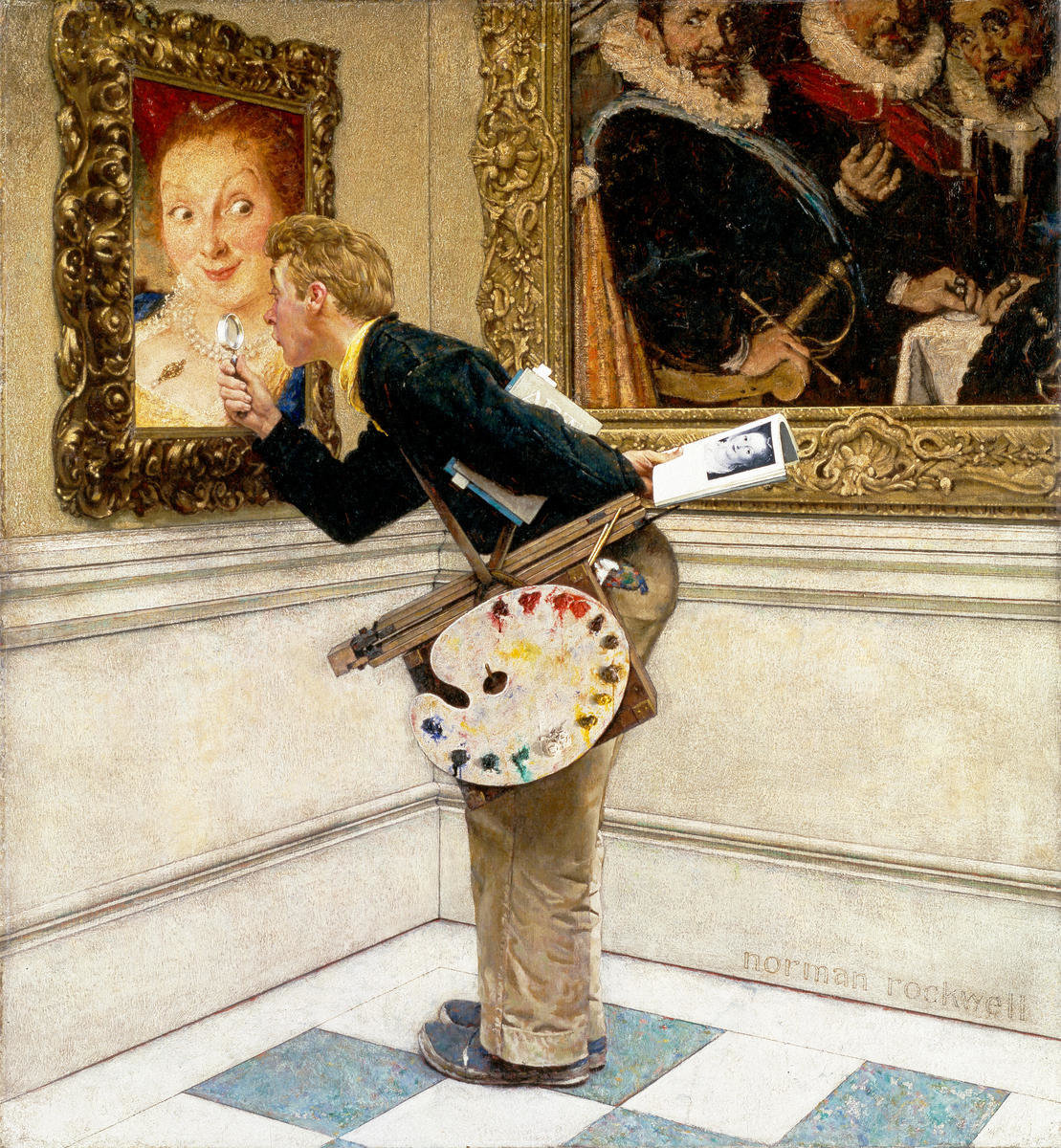
The Art Critic, c. 1955
Cover illustration for The Saturday Evening Post (April 16, 1955)
Oil on canvas
[PETER ROCKWELL] This young man is standing in a museum, just like you. He’s an art student, with his palette of colors, collapsible easel and textbook tucked under his arm. The model is my brother Jarvis, who actually was an art student at the time.
Look carefully at the guidebook he’s carrying behind his back. Here we see a serious, authentic old master portrait of a lady, which makes the saucy expression of the woman in the actual painting even more comic.
In the first sketches my father made for this work he experimented with a range of expressions for the woman–from mild annoyance at the young man’s attentions, to absolute outrage. But then he turned her into a flirt.
Behind the young man, the figures in the other painting look on disapprovingly as he leans in just a bit too close with his magnifying glass.
The title of this picture is “The Art Critic,” raising the question, who is the critic here? The student, or the Lady? Or the fellows looking on in the other painting?
Family
Norman Rockwell
The Art Critic, c. 1955
Cover illustration for The Saturday Evening Post (April 16, 1955)
Oil on canvas
[NORMAN ROCKWELL CHARACTER] This fellow is standing in the same place you are–in an art museum. He’s brought his own art supplies, including a palette full of wet paint! And to get a good look at the painting, he’s holding his magnifying glass awwwfully close to it, don’t’cha think?
Actually, I posed him like that so that everyone would know that he’s an art student. In his back hand, he’s holding a picture of a painting he came to see…and I guess he’s found it! Look closely–in the book, the lady has the same pearls in her hair, but she has a calm face. And in the painting with that fancy frame….ooh boy, she’s giving that young man such a look!
[NORMAN ROCKWELL CHARACTER] The young man is so interested in her jewelry that he doesn’t even notice. But do you see some people in the painting that do notice? That’s right -the men in the other painting!
Spanish
Norman Rockwell
The Art Critic, c. 1955
Cover illustration for the Saturday Evening Post (April 16, 1955)
Oil on canvas
Norman Rockwell: Este muchacho está visitando el mismo lugar que tú, un museo de arte. Ha llevado consigo sus materiales de artista, incluyendo una paleta llena de pinturas húmedas. Y para ver bien el cuadro sostiene una lupa demasiado cerca de la pintura, ¿no crees? En realidad le dije que pusiera esa pose de manera que todos supieran que era un estudiante de arte. Sobre la espalda sostiene una fotografía del cuadro que fue a ver, y creo que lo encontró.
Mira de cerca y verás que en el libro la mujer lleva perlas en el cabello, pero tiene una expresión apacible en la cara; mientras que en la pintura con el marco tan elegante, más bien lo mira con bastante descaro.[risas] Norman Rockwell: El joven está tan interesado en las joyas de la dama, que ni siquiera se da cuenta. ¿Pero puedes ver que otras personas sí se dieron cuenta? En efecto, los hombres que aparecen en el otro cuadro.
Spanish Family
Norman Rockwell
The Art Critic, c. 1955
Cover illustration for the Saturday Evening Post (April 16, 1955)
Oil on canvas
Norman Rockwell: Este muchacho está visitando el mismo lugar que tú, un museo de arte. Ha llevado consigo sus materiales de artista, incluyendo una paleta llena de pinturas húmedas. Y para ver bien el cuadro sostiene una lupa demasiado cerca de la pintura, ¿no crees? En realidad le dije que pusiera esa pose de manera que todos supieran que era un estudiante de arte. Sobre la espalda sostiene una fotografía del cuadro que fue a ver, y creo que lo encontró.
Mira de cerca y verás que en el libro la mujer lleva perlas en el cabello, pero tiene una expresión apacible en la cara; mientras que en la pintura con el marco tan elegante, más bien lo mira con bastante descaro.[risas]
Norman Rockwell: El joven está tan interesado en las joyas de la dama, que ni siquiera se da cuenta. ¿Pero puedes ver que otras personas sí se dieron cuenta? En efecto, los hombres que aparecen en el otro cuadro.