
English
Norman Rockwell
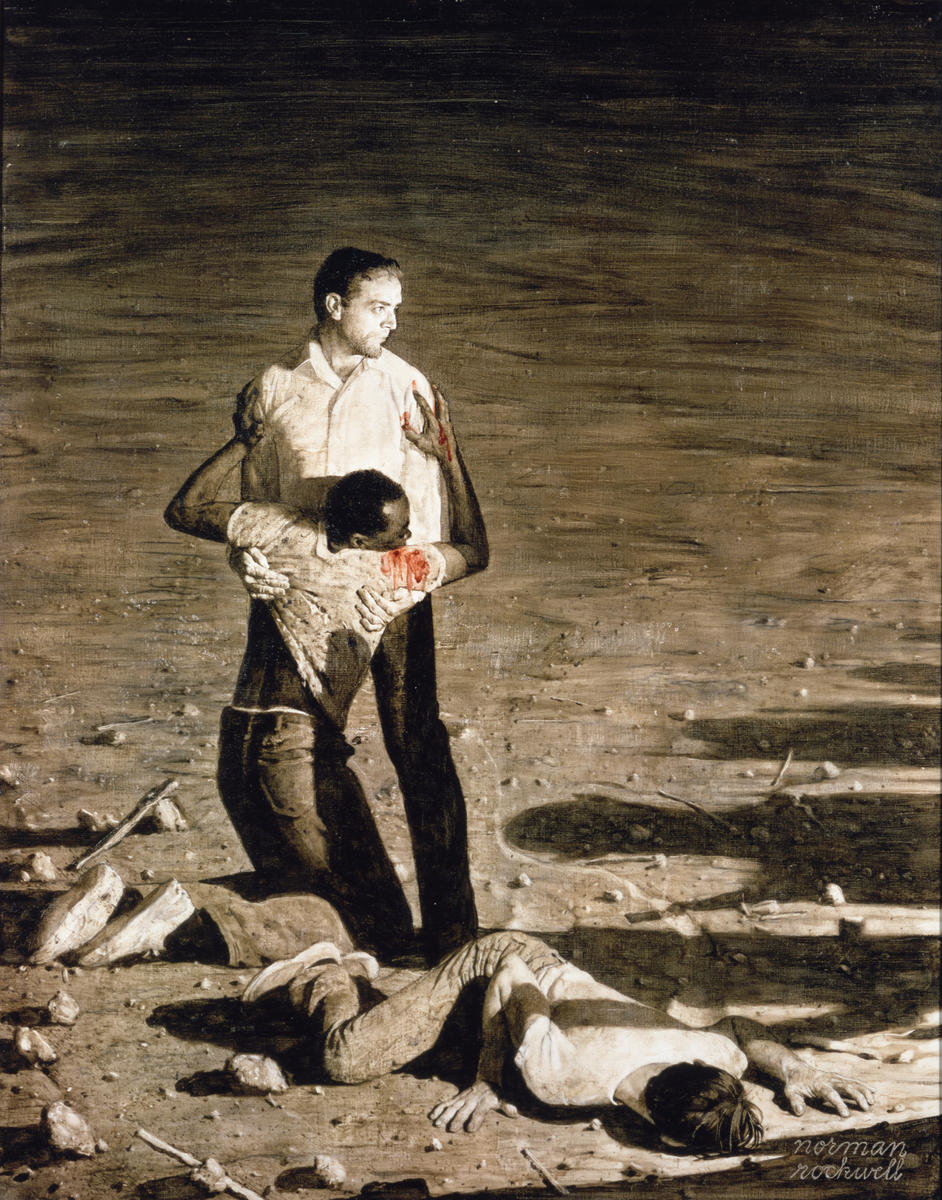
Murder in Mississippi, 1965
Unpublished illustration for Southern Justice, Look, June 29, 1965
Oil on Canvas
Norman Rockwell Museum Collection
PETER ROCKWELL: This image tells the story of three civil rights workers murdered by members of the Ku Klux Klan in 1964. Michael Schwerner, Andrew Goodman, and James Chaney were in Philadelphia, Mississippi, when they were kidnapped and shot.
Here, we see the moment of the attack. Harsh light rakes in from the right, as if from car headlights. It illuminates an anonymous, barren landscape that might as well be the surface of the moon. Sprawled on the ground is Goodman, who is either wounded, or already dead. In the center, the bleeding Chaney collapses in the arms of Schwerner, who turns to confront the attackers. All we see of the Klansmen are their menacing shadows.
For much of his career, my father worked on several projects at a time. But this assignment was different. For five weeks he worked on this image alone.
Additional Tour Content
Narrated By:
Daisy Rockwell
Artist and Author
I think it’s inspiring in the sense that we all have that potential within us to bring more to the world around us if we open our eyes more, and I think his eyes were opened also by, obviously . . . the passions of the Civil Rights movement inspired him as well. I mean it’s not like I ever sat down and asked him these things, but you can read that as part of the trajectory when you look at the changes in his paintings. It seems like that time changed a lot of people, and he was not immune, and I feel that narrative is still not known to a lot of the public, so I’m glad it will be part of the Four Freedoms show. Because that is an evolution from the 40s to the 60s that he went through, and you can’t look at just one and not the other.
I definitely think that art can make people engage because when we have sort of severe problems in our society, part of the problem is we get stuck in our thinking. People’s ideas get ossified, and it’s, you know, today even worse than it’s ever been, probably. People get stuck, and they can’t get each other out of these spaces. You know, there’s right and there’s wrong and there’s black and there’s white, and they can’t . . . so a job that the artist can do is break everything, you know, think of it as a china plate and the artist smashes it, and then glues it back together in another shape so that you can see it differently.
Spanish
Norman Rockwell
Asesinato en Mississippi, 1965
Ilustración no publicada para Southern Justice, Look, 29 de junio de 1965
Óleo sobre lienzo
Colección del Museo Norman Rockwell
Peter Rockwell: Esta imagen narra la historia de tres trabajadores a favor de los derechos civiles que fueron asesinados por miembros del Ku Klux Klan en 1964. Michael Schwerner, Andrew Goodman y James Chaney se encontraban en Philadelphia, Mississippi, cuando fueron secuestrados y asesinados a tiros.
En esta obra presenciamos el momento del ataque. Una luz intensa se filtra desde el lado derecho, como si se tratara de los faros de un automóvil. Ilumina un estéril paisaje anónimo que muy bien podría ser la superficie de la luna. Tirado sobre la tierra se encuentra Goodman, quien esta herido, o ya muerto. Al centro Chaney se desploma sangrando en los brazos de Schwerner, quien se voltea para enfrentarse a los agresores. Lo único que podemos ver de los victimarios son sus amenazadoras sombras.
Durante una gran parte de su trayectoria artística, mi padre trabajó en varios proyectos a la vez, pero este fue diferente; durante cinco semanas consecutivas trabajó exclusivamente en esta imagen. Puede obtener mayor información sobre el proceso de creación en la pared cercana.
Contenido adicional del audioguía — Daisy Rockwell
Narrado por:
Daisy Rockwell
Artista and Autora
Creo que es inspirador en el sentido de que todos tenemos ese potencial dentro de nosotros para traer más al mundo que nos rodea si abrimos nuestros ojos más, y creo que sus ojos también se abrieron, obviamente. . . las pasiones del movimiento de Derechos Civiles también lo inspiraron. Quiero decir que no es como si alguna vez me hubiera sentado y le hubiera preguntado estas cosas, pero puedes leer eso como parte de la trayectoria cuando mires los cambios en sus pinturas. Parece que ese momento cambió a mucha gente, y él no era inmune, y creo que la narrativa todavía no es conocida por gran parte del público, así que me alegro de que sea parte del programa Four Freedoms (Las Cuatro Libertades). Porque esa es una evolución desde los años 40 hasta los 60 que atravesó, y no se puede ver solo uno y no el otro.
Definitivamente creo que el arte puede hacer que las personas participen porque cuando tenemos problemas serios en nuestra sociedad, parte del problema es que nos quedamos atrapados en nuestro pensamiento. Las ideas de la gente se osifican, y es, ya sabes, hoy incluso peor de lo que ha sido alguna vez, probablemente. La gente se atasca y no pueden separarse de estos espacios. Ya sabes, está bien y está mal y hay negro y blanco, y no pueden. . . así que un trabajo que el artista puede hacer es romperlo todo, ya sabes, pensar en él como un plato de porcelana y el artista lo rompe, y luego lo pega de nuevo en otra forma para que pueda verlo de manera diferente.