
English
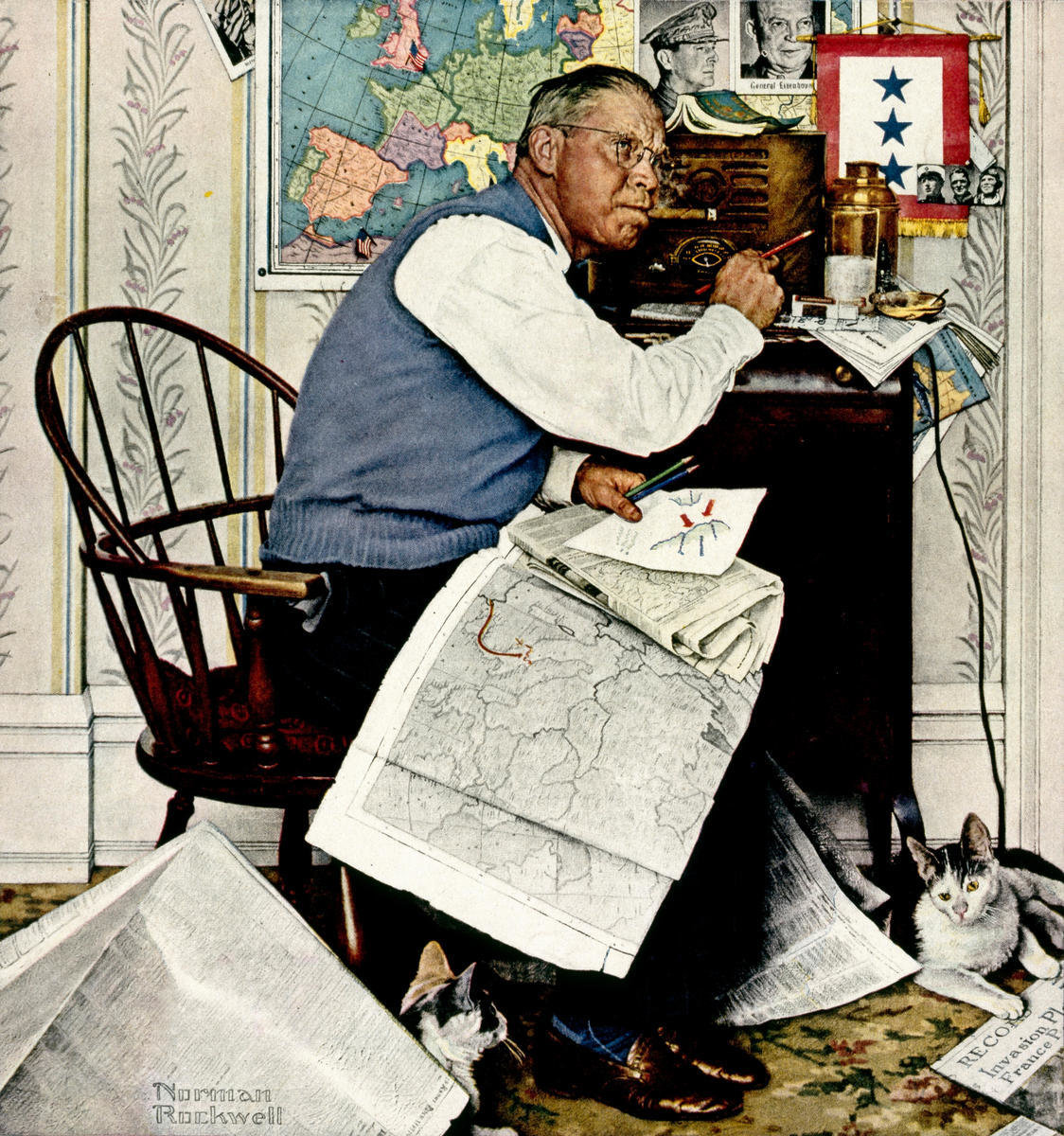
Man Charting War Maneuvers
Cover illustration for The Saturday Evening Post, April 29, 1944
Oil on canvas
By Norman Rockwell
Private Collection
© 1944 SEPS – Curtis Publishing
War News
Intended cover for The Saturday Evening Post, unpublished, 1944
Oil on canvas
By Norman Rockwell
Norman Rockwell Museum Collection
Narrated By:
Stephanie Haboush Plunkett
Deputy Director / Chief Curator – Norman Rockwell Museum
In this April 29, 1944 cover for the Saturday Evening Post, a man is literally charting war maneuvers as he listens to the radio and holds in his hands several maps that would represent the places where his own sons were stationed. The image is a detailed portrayal of what a parent’s own experience might actually be during World War II. We can see in the painting that the man has a flag with three blue stars, noting that each of his sons is engaged in the war. By their photographs, we learn that one is in the Army, one in the Navy, and one in the Air Corps.
If he had actually been listening to the radio at that time, he might come upon the music of the Glen Miller Orchestra, or perhaps even a show called You Can’t Do Business With Hitler, which was a radio series written and produced by the Office of War Information. One of thousands of government propaganda plays that were broadcast to support the war effort.
Rockwell would typically use props that he had in his own studio in his paintings. One of the objects that we identify here was Rockwell’s own Windsor chair, which the man is seated on. The Windsor chair that you see here is the actual type of chair that Rockwell typically painted on, though he did sometimes paint standing up. It was a chair that he actually took with him from studio to studio.
The image that you see here is actually the second that Rockwell created, on the concept of listening to news of the war. The first was actually an unpublished image that Rockwell worked on in the winter of 1944, and that he and the Saturday Evening Post deemed unreadable. In it, we see a group of men gathered in a diner, and though they all appear to be very attentive, we are not exactly sure what they’re listening to. If we look closely, in the upper right hand corner of the painting, there’s a glowing light that comes from a playing radio. As an illustrator for a mass published magazine, Rockwell had to tell his story very quickly, and his imagery had to appeal to a very vast audience. In this case, The War News is a beautiful painting, it did not communicate effectively in the way that Rockwell would have hoped, and so he chose to abandon this particular way of telling the story.
Spanish
Man Charting War Maneuvers (Hombre trazando maniobras de guerra)
Ilustración de portada de The Saturday Evening Post, 29 de abril de 1944
Óleo sobre lienzo
Por Norman Rockwell
Colección privada
© 1944 SEPS – Curtis Publishing
War News (Noticias de guerra)
Capa prevista de The Saturday Evening Post, inédito, 1944
Óleo sobre lienzo
Por Norman Rockwell
Colección del Museo Norman Rockwell
Narrado por:
Stephanie Haboush Plunkett
Directora Adjuntoa/Curadora Jefe – Museo Norman Rockwell
En esta capa del The Saturday Evening Post del 29 de abril de 1944, un hombre está literalmente trazando maniobras de guerra mientras escucha la radio y tiene en sus manos varios mapas que representarían los lugares donde sus propios hijos estaban en misiones. La imagen es una representación detallada de lo que la propia experiencia de un padre podría ser durante la Segunda Guerra Mundial. Podemos ver en la pintura que el hombre tiene una bandera con tres estrellas azules, y señala que cada uno de sus hijos está involucrado en la guerra. Por sus fotografías, nos enteramos de que uno está en el Ejército, uno en la Marina de Guerra y uno en la Fuerza Aérea.
Si en realidad hubiera estado escuchando la radio en ese momento, podría toparse con la música de la Orquesta Glen Miller, o tal vez incluso un programa llamado “No se puede hacer negocios con Hitler”, que era una serie de radio escrita y producida por Oficina de Información de Guerra de Estados Unidos. Una de las miles de obras de propaganda del gobierno que se transmitieron para apoyar el esfuerzo de guerra.
Rockwell usualmente usaba accesorios que tenía en su propio estudio en sus pinturas. Uno de los objetos que identificamos aquí fue la silla Windsor de Rockwell, en la que el hombre está sentado. La silla Windsor que ves aquí es el tipo de silla en que Rockwell normalmente pintaba, aunque a veces pintaba de pie. Era una silla que en realidad llevó consigo de estudio en estudio.
La imagen que ves aquí es en realidad la segunda que creó Rockwell, sobre el concepto de escuchar las noticias de la guerra. La primera fue en realidad una imagen inédita en la que Rockwell trabajó en el invierno de 1944, y que él y el Saturday Evening Post consideraron ilegible. En ella, vemos a un grupo de hombres reunidos en un restaurante, y aunque todos parecen estar muy atentos, no estamos exactamente seguros de lo que están escuchando. Si miramos de cerca, en el rincón superior derecho de la pintura, hay una luz brillante que proviene de una radio en reproducción. Como ilustrador de una revista de publicación masiva, Rockwell tuvo que contar su historia muy rápidamente, y sus imágenes tuvieron que atraer a un público muy vasto. En este caso, War News es una pintura hermosa, pero no se comunicó efectivamente de la forma en que Rockwell habría esperado, por lo que optó por abandonar esta manera particular de contar la historia.
French
Cartographie de l’Homme Manoeuvres de guerre
Illustration de couverture pour Le Saturday Evening Post, 29 avril 1944
Huile sur toile
Par Norman Rockwell
Collection Privée
© 1944 SEPS – Éditions Curtis
Nouvelles de la Guerre
Couverture prévue pour le Saturday Evening Post, non publié, 1944
Huile sur toile
Par Norman Rockwell
Collection du Musée Norman Rockwell
Raconté Par:
Stephanie Haboush Plunkett
Directeur Adjoint / Conservateur en Chef – Musée Norman Rockwell
Dans cette couverture du Saturday Evening Post du 29 avril 1944, un homme trace littéralement des manœuvres de guerre en écoutant la radio et tient entre ses mains plusieurs cartes qui représenterait les endroits où ses fils étaient stationnés. L’image est une représentation détaillée de ce que l’expérience personnelle d’un parent pourrait être pendant la Seconde Guerre mondiale. Nous pouvons voir dans la peinture que l’homme a un drapeau avec trois étoiles bleues, notant que chacun de ses fils est engagé dans la guerre. Par leurs photographies, nous apprenons que l’un d’eux est dans l’Armée, un d’eux est dans la Marine et un d’eux dans les Forces Aériennes.
S’il était effectivement en train d’écouté la radio à ce moment-là, il aurait pu trouver la musique de l’Orchestre Glen Miller, ou peut-être même un spectacle intitulé Vous ne Pouvez pas Faire des Affaires avec Hitler, qui était une série radiophonique écrite et produite par le Bureau de l’information de Guerre. Un des milliers de pièces de propagande du gouvernement qui ont été diffusées pour soutenir l’effort de guerre.
Rockwell utilisait généralement les accessoires qu’il avait dans son propre studio dans ses peintures. L’un des objets que nous identifions ici est la Chaise Windsor de Rockwell, sur laquelle l’homme est assis. La Chaise Windsor que vous voyez ici est le type de chaise actuel sur lequel Rockwell peignait généralement, bien que parfois il peignait debout. C’était une chaise qu’il avait emmenée de studio en studio.
L’image que vous voyez ici est en fait la seconde que Rockwell a créée, sur le concept d’écoute des nouvelles de la guerre. La première était en fait une image inédite sur laquelle Rockwell travailla durant l’hiver 1944, et que lui et le Saturday Evening Post jugèrent illisibles. Dans celui-ci, nous voyons un groupe d’hommes rassemblés dans un restaurant, et bien qu’ils semblent tous être très attentifs, nous ne savons pas exactement ce qu’ils écoutent. Si nous regardons de près, dans le coin supérieur droit du tableau, il y a une lumière rougeoyante qui provient d’une radio qui joue. En tant qu’illustrateur pour un magazine publié en masse, Rockwell a dû raconter son histoire très rapidement, et son imagerie a dû faire appel à un public très large. Dans ce cas, Les Nouvelles de la Guerre est une belle peinture, il ne communiquait pas de la manière dont Rockwell l’aurait espéré, et il a donc choisi d’abandonner cette manière spécifique de raconter l’histoire.
German
Man Charting War Maneuvers (Mann, der Kriegsmanöver aufzeichnet)
Titelblatt-Illustration für The Saturday Evening Post, 29. April 1944
Öl auf Leinwand
Von Norman Rockwell
Privatsammlung
© 1944 SEPS – Curtis Publishing
War News (Kriegsnachrichten)
Als Titelbild für The Saturday Evening Post gedacht, unveröffentlicht, 1944
Öl auf Leinwand
Von Norman Rockwell
Norman Rockwell Museumssammlung
Erzählt von:
Stephanie Haboush Plunkett
Stellvertretende Leiterin / Chefkuratorin – Norman Rockwell Museum
Auf dieser Titelseite der Saturday Evening Post vom 29. April 1944 zeichnet ein Mann im wahrsten Sinn des Wortes Kriegsmanöver auf, während er Radio hört und mehrere Landkarten in der Hand hält, auf denen die Orte zu sehen sind, an denen seine eigenen Söhne stationiert sind. Das Bild ist eine detaillierte Darstellung dessen, was ein Elternteil während des Zweiten Weltkriegs tatsächlich erlebt haben könnte. Wir sehen auf dem Gemälde, dass der Mann eine Flagge mit drei blauen Sternen hat, und stellen fest, dass jeder seiner Söhne in dem Krieg im Einsatz ist. Anhand der Fotografien erfahren wir, dass einer bei der Armee, einer bei der Marine und einer im Fliegerkorps ist.
Sollte er damals tatsächlich Radio gehört haben, ist er vielleicht auf die Musik des Glen Miller Orchestra gestoßen, oder möglicherweise sogar auf eine Sendung namens You Can’t Do Business With Hitler, eine vom Amt für Kriegsberichterstattung produzierte Radioserie. – Eines von tausenden Propaganda-Stücken der Regierung, die ausgestrahlt wurden, um die Kriegsanstrengungen zu unterstützen.
Rockwell verwendete für seine Gemälde in der Regel Requisiten aus dem eigenen Atelier. Einer der Gegenstände, die wir hier erkennen, ist Rockwells eigener Windsor-Stuhl, auf dem der Mann sitzt. Bei dem Windsor-Stuhl, der hier zu sehen ist, handelt es sich genau um jene Art von Stuhl, auf der Rockwell in der Regel saß, wenn er malte, obwohl er manchmal auch im Stehen arbeitete. Es war ein Stuhl, den er tatsächlich von Atelier zu Atelier mitnahm.
Das Bild, das man hier sieht, ist eigentlich das zweite, das Rockwell zum Thema Kriegsnachrichtenhören schuf. Das erste war ein unveröffentlichtes Bild, an dem Rockwell im Winter 1944 arbeitete und das er und die Saturday Evening Post als schwer zu deuten erachteten. Darauf sehen wir eine Gruppe von Männern in einer Imbissstube, und obwohl sie alle sehr konzentriert zu lauschen scheinen, wissen wir nicht genau, wem ihre Aufmerksamkeit gilt. Wenn wir genauer hinschauen, ist da in der rechten oberen Ecke des Gemäldes ein glühendes Licht, das von einem laufenden Radio herrührt. Als Illustrator eines in Massenauflage erscheinenden Magazins musste Rockwell seine Geschichte sehr kurz und bündig erzählen, und seine Bildsprache musste bei einem sehr breiten Publikum Anklang finden. Im vorliegenden Fall ist War News zwar ein schönes Gemälde, aber nicht so aussagekräftig, wie Rockwell es sich gewünscht hätte, und so beschloss er, diese spezielle Art, die Geschichte zu erzählen, nicht weiterzuverfolgen.
Japanese
Man Charting War Maneuvers
マン・チャート戦争操作
Cover illustration for The Saturday Evening Post, April 29, 1944
1944年4月29日サタデイイブニングポスト誌の表紙イラスト
Oil on canvas
オイルキャンバス
By Norman Rockwell
ノーマン・ロックウェル作
Private Collection
プライベートコレクション
© 1944 SEPS – Curtis Publishing
©1944 SEPS -カーティス出版
War News
戦争ニュース
Intended cover for The Saturday Evening Post, unpublished, 1944
1944年に未発表の「サタデイイブニングポスト」の予定表紙
Oil on canvas
オイルキャンバス
By Norman Rockwell
ノーマン・ロックウェル作
Norman Rockwell Museum Collection
ノーマンロックウェルミュージアムコレクション
Narrated By: Stephanie Haboush Plunkett
Deputy Director / Chief Curator – Norman Rockwell Museum
ステファニー・ハボース・プランケットによるナレーション付き:
副所長/チーフキュレーター – ノーマンロックウェル博物館
In this April 29, 1944 cover for the Saturday Evening Post, a man is literally charting war maneuvers as he listens to the radio and holds in his hands several maps that would represent the places where his own sons were stationed.
1944年4月29日付のサタデイイブニングポスト誌のカバーには、ラジオを聴きながら自分の息子が駐留していた場所を表すいくつかの地図を手にする男が実際に戦術を描いている様子が載せられてます。
The image is a detailed portrayal of what a parent’s own experience might actually be during World War II.
この画像は、第二次世界大戦中における親自身の経験が実際にどのようなものかを詳細に描いたものです。
We can see in the painting that the man has a flag with three blue stars, noting that each of his sons is engaged in the war.
絵の中には、3つの青い星がついた旗があり、息子たちがそれぞれ戦争に従事していることがわかります。
By their photographs, we learn that one is in the Army, one in the Navy, and one in the Air Corps.
それらの写真では、陸軍に1人、海軍に1人、航空隊に1人がいることがわかります。
If he had actually been listening to the radio at that time, he might come upon the music of the Glen Miller Orchestra, or perhaps even a show called You Can’t Do Business With Hitler, which was a radio series written and produced by the Office of War Information.
当時彼が実際にラジオを聴いていたのであれば、グレン・ミラー・オーケストラの音楽を聴いたかもしれず、「ヒットラーと取引はするな」という番組でさえ、恐らくは戦争情報局によって編集されたラジオシリーズでした。
One of thousands of government propaganda plays that were broadcast to support the war effort.
戦争努力を支えるために放送された数千の政府プロパガンダ劇の一つだったのです。
Rockwell would typically use props that he had in his own studio in his paintings.
ロックウェルは彼の絵画の中で自分のスタジオで持っていた小道具を使うのが常でした。
One of the objects that we identify here was Rockwell’s own Windsor chair, which the man is seated on.
私たちがここで特定している物体の1つは、ロックウェルが所有するウィンザーチェアで、男が座っています。
The Windsor chair that you see here is the actual type of chair that Rockwell typically painted on, though he did sometimes paint standing up.
ここでご覧になるウィンザーチェアは、ロックウェルが典型的に描いた椅子の実際のタイプです。
It was a chair that he actually took with him from studio to studio.
それはスタジオからスタジオへ彼が実際に持ち運んだ椅子です。
The image that you see here is actually the second that Rockwell created, on the concept of listening to news of the war.
あなたがご覧になっている画像は、実際には、戦争のニュースを聞くというコンセプトで、ロックウェルが作成した2番目の画像です。
The first was actually an unpublished image that Rockwell worked on in the winter of 1944, and that he and the Saturday Evening Post deemed unreadable.
最初はロックウェルが1944年の冬に作成した未発表の画像であり、彼とサタデイイブニングポストは判読できない(無表情)と考えていました。
In it, we see a group of men gathered in a diner, and though they all appear to be very attentive, we are not exactly sure what they’re listening to.
そこでは食堂に集まった一群の男性が見うけられます。彼らはすべて非常に集中しているように見えますが、彼らが何を聞いているのか正確にはわかりません。
If we look closely, in the upper right hand corner of the painting, there’s a glowing light that comes from a playing radio.
よく見ると、絵の右上隅には、放送中のラジオから放たれる光があります。
As an illustrator for a mass published magazine, Rockwell had to tell his story very quickly, and his imagery had to appeal to a very vast audience.
大量に出版された雑誌のイラストレーターとして、ロックウェルは急いでストーリーを伝えなければならず、彼の画像は非常に広大な聴衆にアピールしなければならなかったのです。
In this case, The War News is a beautiful painting, it did not communicate effectively in the way that Rockwell would have hoped, and so he chose to abandon this particular way of telling the story.
このケースでは、「戦争ニュース」は美しい絵となってしまい、ロックウェルが望んでいた方法で効果的に伝えることができなかったので、彼はストーリーを伝えるこの特定の方法を放棄することを選びました。
Chinese
绘制军事演习的男人
《星期六晚报》封面插图,1944年4月29日
布面油画
创作者/诺曼·洛克威尔
私人收藏
© 1944 SEPS – Curtis Publishing
战争新闻
《星期天晚报》原定封面,未出版,1944年
布面油画
创作者/诺曼·洛克威尔
诺曼·洛克威尔博物馆收藏
讲述人:
Stephanie Haboush Plunkett
副总监 / 总策展人 – 诺曼·洛克威尔博物馆
在这幅1944年4月29日《星期六晚报》的封面图中,一位男子正边收听广播边绘制战争演习图,手中握着几份地图,对应自己几个儿子所驻扎的地方。这幅画描绘了二战期间父母的自身经历。从画中可以看到,这位男子有一面三星蓝旗,表示他的几个儿子都在参战。根据他们的照片,我们可得知一个是陆军、一个是海军、一个是空军。
如果他当时在听广播的话,他可能会听到格伦·米勒管弦乐团的曲子,甚至有可能是一个叫“你不能和希特勒做生意”的节目,这是一个由战时新闻处编写并制作的广播剧。也是万千为支持战争而播出的政府宣传节目之一。
洛克威尔常常会将自己工作室中的道具放入画中。其中一个可以确定的道具就是洛克威尔自己的温莎椅,也就是画中男子所坐的椅子。大家这里所看到的温莎椅正是洛克威尔作画时所坐椅子的同款,虽然他有时也会站着画画。这也是他无论搬到哪个工作室都会带着的一把椅子。
大家这里看到的其实是洛克威尔创作的第二幅与收听战时新闻有关的作品。第一幅作品是洛克威尔在1944年冬天创作的作品,最终因为他和《星期六晚报》认为作品无法解读而未发表。在画中,我们可以看到一群人围坐在餐馆中,虽然他们看上去非常专心,但我们并无法推测他们听的是什么。看得再仔细一点,可以看到画的右上方有一束播放着的收音机发出的光芒。作为一名大众出版杂志的插画师,洛克威尔必须非常迅速地把故事说清楚,他的画也必须能吸引广大群众。因此,尽管战争新闻这幅画非常美,但它并未能如洛克威尔所希望地有效传达信息,所以他选择了放弃这种特别的艺术叙述方式。
Arabic
رجل يخطط لمناورات الحرب
رسم لغلاف جريدة “ساترداي إيفنينغ بوست”، 29 أبريل 1944
رسم زيتي على القماش
لـ نورمان روكويل
مجموعة خاصة
© 1944 SEPS – كورتيس للنشر
أخبار الحرب
غلاف مُزمع لجريدة “ساترداي إيفنينغ بوست”، غير منشور، 1944
رسم زيتي على القماش
لـ نورمان روكويل
مجموعة متحف نورمان روكويل
الراوي:
ستيفاني هابوش بلونكيت
نائب مدير / رئيسة أمناء المتحف – متحف نورمان روكويل
في هذا الغلاف بتاريخ 29 أبريل 1944 لجريدة “ساترداي إيفنينغ بوست”، يقوم رجل بالتخطيط حرفيا لمناورات حربية فيما ينصت للمذياع ويحمل في يديه العديد من الخرائط التي قد تشير إلى الأماكن التي يوجد فيها أبناؤه. تعتبر الصورة تصويرا مفصّلا عمّا قد يختبره الآباء أثناء الحرب العالمية الثانية. يمكننا أن نرى من خلال الصورة أنّ الرجل يمتلك علما به ثلاث نجمات زرقاء تشير إلى أنّ كل واحد من أبنائه مشارك في الحرب. من خلال صورهم نعرف أنّ واحدا منهم في الجيش، والثاني في البحرية، فيما يوجد الثالث في سلاح الجوية.
إذا كان يصغي فعلا للمذياع حينها، فلعله صادف موسيقى جوقة “جلين ميلر”، أو ربما حتى برنامجا عنوانه “لا يمكنك التعامل مع هتلر”، والذي كان عبارة عن سلسلة إذاعية كتبها وأنتجها “مكتب المعلومات الحربية”. واحدة من بين آلاف المسرحيات الدعائية الحكومية التي تم بثها لدعم الجهود الحربية.
عادة ما كان روكويل يستخدم دعائم موجودة في الاستديو الخاص به في رسوماته. أحد الأشياء التي يمكننا تحديدها هنا هو كرسي وندسور الخاص بروكويل، والذي يجلس عليه الرجل. كرسي وندسور الذي ترونه هنا هو الصنف الحقيقي للكرسي الذي كان روكويل يرسم وهو جالس عليه عادة، على الرغم من إنجازه لبعض الرسومات وهو واقف. لقد كان كرسيا أخذه معه من استديو إلى آخر.
الصورة التي ترونها هنا هي ثاني صورة صممها روكويل على أساس فكرة الاستماع إلى أخبار الحرب. الأولى كانت في الحقيقة صورة غير منشورة عمل عليها روكويل في شتاء سنة 1944، وقد اعتبرها وجريدة “ساترداي إيفنينغ بوست” غير قابلة للقراءة. نرى فيها مجموعة من الرجال مجتمعين من أجل العشاء، وعلى الرغم من أن ملامحهم تظهر أنهم منتبهون، إلّا أنه لا يمكننا التأكّد ممّا يصغون إليه تحديدا. إذا ما نظرنا عن قرب، في الجزء العلوي الأيمن للصورة، هنالك ضوء متوهج صادر عن المذياع المشتغل. بصفته رساما لجريدة كثيرة الإصدار، كان على روكويل أن يحكي قصته بسرعة، ووجب على صورته أن تجذب جمهورا واسعا جدّا. في هذه الحالة، تعتبر “أخبار الحرب” صورة جميلة، لكنها تعجز عن التواصل بفعالية بالطريقة التي كان روكويل يأمل أن تفعل، لهذا اختار التخلّي عن هذه الطريقة في الإخبار بالقصّة.