
English
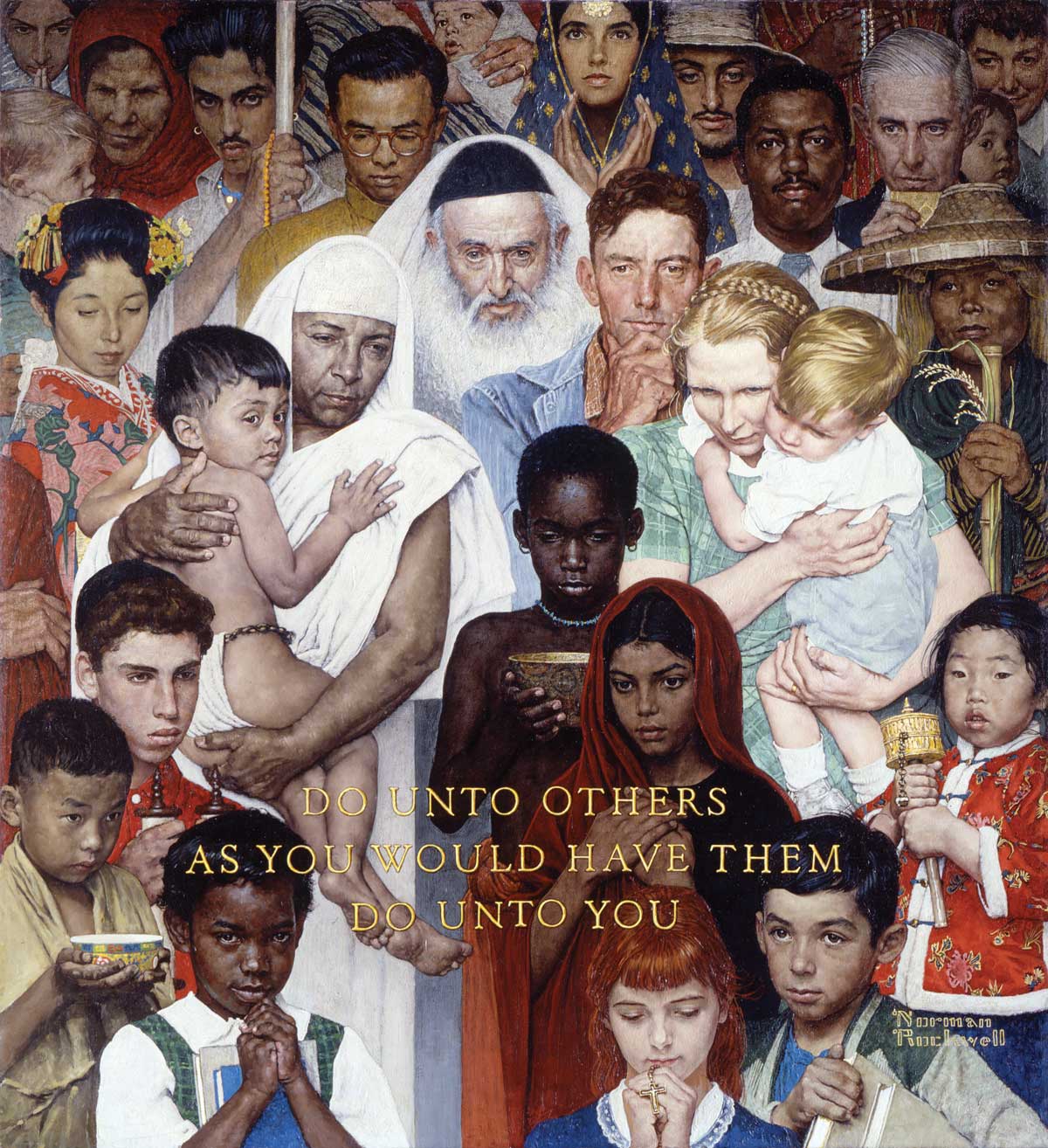
Golden Rule – Norman Rockwell
Cover illustration for The Saturday Evening Post, April 1, 1961
Oil on canvas
Norman Rockwell Museum Collection
© 1961 SEPS – Curtis Publishing
Narrated By:
Stephanie Haboush Plunkett
Deputy Director / Chief Curator – Norman Rockwell Museum
Norman Rockwell’s April 1st 1961, Saturday Evening Post cover, Golden Rule actually started out as a drawing. In 1952 at the height of The Cold War and two years into the Korean War, Rockwell conceived an image of The United Nations as the world’s hope for the future. His appreciation for the organization and its mission inspired a complex work portraying members of The United Nations’ Security Council and 65 people representing the nations of the world. A study for an artwork that he originally intended to complete in painted form, researched and developed to the final drawing stage, the artist’s United Nations piece never actually made it to canvas.
Of his work on The United Nations drawing, Rockwell said, “Like everyone else, I’m concerned with the world’s situation and like everyone else, I’d like to contribute something to help. The only way I can contribute is through my pictures.” A perfectionist in his art, Rockwell went to elaborate lengths to create photographs that portrayed his concepts exactly and to find just the right models for his work. He researched costumes and props and carefully orchestrated each element of the design to be photographed before putting paint to canvas.
Using his photographs as a reference, Rockwell worked with the details of composition and value in this richly detailed black and white drawing, created with Wolff pencil and charcoal. “I take the making of the charcoal layouts very seriously.” he said, “Too many novices, I believe, wait until they are on the canvas before trying to solve many of their problems. It is much better to wrestle with them ahead though studies.”
Though he was dedicated to the concept of this work, he ultimately found it too complex to create as a final illustration and eventually, about seven years later, explored the possibility of a new approach which he took in Golden Rule.
Rockwell said, “One day I suddenly go the idea that The Golden Rule, do unto others as you would have them do unto you, was the subject I was looking for.”
In Golden Rule, Rockwell portrays four sets of mothers and their children. The one in the upper right hand corner actually represents his second wife Mary Barstow Rockwell who had passed away in 1959, two years before this image was published. Here she is united with her first grandchild, Geoffrey Rockwell, who she never actually had the opportunity to meet.
Published almost six decades ago, Norman Rockwell’s Golden Rule is one of his most iconic images, portraying our common humanity and reflecting Rockwell’s own beliefs, which remain relevant for our times.
Spanish
Golden Rule (Regla de bro)
Ilustración de portada para The Saturday Evening Post, 1 de abril de 1961
Óleo sobre lienzo
Por Norman Rockwell
Colección del Museo Norman Rockwell
© 1961 SEPS – Curtis Publishing
Narrado por:
Stephanie Haboush Plunkett
Directora Adjunta/Curadora Jefe – Museo Norman Rockwell
La portada del Saturday Evening Post del 1 de abril de 1961 de Norman Rockwell, Golden Rule en realidad comenzó como un dibujo. En 1952, en el apogeo de la Guerra Fría y dos años después de la Guerra de Corea, Rockwell concibió una imagen de las Naciones Unidas como la esperanza mundial para el futuro. Su aprecio por la organización y su misión inspiró una obra compleja que retrata a los miembros del Consejo de Seguridad de las Naciones Unidas y a 65 personas que representan a las naciones del mundo. Un estudio para una obra de arte que originalmente tenía la intención de completar en forma pintada, investigó y desarrolló hasta la etapa de dibujo final, la pieza de United Nations del artista nunca llegó a la realidad.
Sobre su trabajo en el dibujo de The United Nations, Rockwell dijo, “Al igual que todos los demás, me preocupa la situación mundial y, como todos los demás, me gustaría aportar algo para ayudar. La única forma en que puedo contribuir es a través de mis imágenes.” Un perfeccionista
Usando sus fotografías como referencia, Rockwell trabajó con los detalles de la composición y el valor en este dibujo en blanco y negro ricamente detallado, creado con lápiz y carbón Wolff. “Me tomo la elaboración de los diseños de carbón muy en serio,” él dijo: “Demasiados novatos, creo, esperan hasta que estén sobre el lienzo antes de tratar de resolver muchos de sus problemas. Es mucho mejor luchar con ellos antes con los estudios “.
A pesar de que estaba dedicado al concepto de este trabajo, finalmente descubrió que era demasiado complejo para crearlo como una ilustración final y, finalmente, unos siete años más tarde, exploró la posibilidad de un nuevo enfoque que adoptó en Golden Rule.
Rockwell dijo: “Un día, de repente, llegué a la idea de que The Golden Rule — hacer a los demás lo que quisieras que te hicieran — era el tema que estaba buscando”.
En The Golden Rule, Rockwell retrata cuatro grupos de madres y sus hijos. El que está en el rincón superior derecho en realidad representa a su segunda esposa, Mary Barstow Rockwell, que falleció en 1959, dos años antes de que se publicara esta imagen. Aquí está junto a su primer nieto, Geoffrey Rockwell, a quien nunca tuvo la oportunidad de conocer.
Publicado casi seis décadas atrás, The Golden Rule de Norman Rockwell es una de sus imágenes más emblemáticas, retratando nuestra humanidad común y reflejando las propias creencias de Rockwell, que siguen siendo relevantes para nuestros tiempos.
French
La Règle d’Or
Illustration pour la couverture de Saturday Evening Post, 1er avril 1961
Huile sur toile
Norman Rockwell
Collection du Musée Norman Rockwell
Narratrice :
Stephanie Haboush Plunkett
Directrice adjointe / Conservatrice en Chef – Musée Norman Rockwell
La couverture du Saturday Evening Post du 1er avril 1961, La Règle d’Or, était au départ un dessin. En 1952, à l’apogée de la Guerre froide et deux ans après le début de la Guerre de Corée, Rockwell représenta Les Nations Unies comme un espoir pour le futur. Son respect pour cette institution et sa mission lui inspira un travail complexe mettant en scène les membres du Conseil de sécurité des Nations unies, ainsi que 65 personnes représentant les différentes nations du monde. Cette étude prévue à l’origine pour devenir un tableau nommé Les Nations Unies n’aboutira finalement jamais à une peinture sur toile.
À propos de son travail sur Les Nations Unies, Rockwell disait “comme tout le monde, je me soucie de l’état du monde, et comme tout le monde j’aimerais apporter ma contribution. Et ma seule façon de le faire, c’est à travers ma peinture.”
Très perfectionniste, Rockwell consacra beaucoup de temps à rechercher les modèles adéquats et à les photographier afin de représenter avec précision ce qu’il avait en tête. Il chercha les costumes et les accessoires adaptés et disposa avec précision chaque élément de sa composition pour les photographier avant de commencer à peindre sa toile.
En prenant ces photos comme modèles, Rockwell composa un dessin noir et blanc extrêmement détaillé, réalisé au fusain et au crayon. “J’attache beaucoup d’importance à l’élaboration des esquisses au fusain.” disait-il, “Je pense que beaucoup trop de débutants attendent d’être devant leur toile pour se demander comment aborder certaines difficultés. À mon sens il est préférable de s’y attaquer en faisant d’abord des esquisses.”.
Bien que très investi dans ce travail, il finit par le trouver trop complexe à réaliser. Environ sept ans plus tard, il prit donc la décision de tenter une nouvelle approche avec La Règle d’Or.
Rockwell disait “Un jour, l’idée m’est soudain venue que La Règle d’Or, consistant à dire “Fais aux autres ce que tu aimerais qu’ils te fassent”, était le sujet que je cherchais.”
Dans le tableau La Règle d’Or, Rockwell représente sept mères accompagnées de leurs enfants. Celle qui se trouve sur la droite est d’ailleurs sa seconde épouse, Mary Barstow Rockwell, décédée en 1959, deux ans avant que l’œuvre soit publiée. Elle est ici représentée avec son premier petit-fils, Geoffrey Rockwell, qu’elle n’a en réalité jamais connu.
Publié il y a environ 60 ans, La Règle d’Or est l’un des tableaux les plus emblématiques de Norman Rockwell, représentant notre humanité et reflétant les propres opinions de Rockwell, des opinions toujours pertinentes à notre époque.
German
Golden Rule (Goldene Regel)
Titelblatt-Illustration für The Saturday Evening Post, 1. April 1961
Öl auf Leinwand
Von Norman Rockwell
Norman Rockwell Museumssammlung
© 1961 SEPS – Curtis Publishing
Erzählt von:
Stephanie Haboush Plunkett
Stellvertretende Leiterin / Chefkuratorin – Norman Rockwell Museum
Norman Rockwells Saturday Evening Post-Titelblatt vom 1. April 1961, Golden Rule (Goldene Regel), entstand ursprünglich als Zeichnung. 1952, am Höhepunkt des Kalten Krieges und zwei Jahre nach Beginn des Koreakrieges, entwarf Rockwell ein Bild von den Vereinten Nationen als Zukunftshoffnung für die Welt. Seine Wertschätzung für diese Organisation und ihre Mission dienten ihm als Inspiration für ein komplexes Werk, auf dem Mitglieder des Sicherheitsrates der Vereinten Nationen und 65 Personen, die die Nationen der Welt repräsentieren, dargestellt sind. Als Studie für ein Kunstwerk, welches der Künstler ursprünglich als Gemälde geplant und bis zur endgültigen Fassung ausrecherchiert und zeichnerisch fertig ausgeführt hatte, schaffte es United Nations allerdings niemals wirklich auf die Leinwand.
Über seine Arbeit an der Zeichnung The United Nations sagte Rockwell: „Wie jeder andere auch bin ich über die Lage der Welt besorgt, und wie jeder andere auch möchte ich etwas beitragen, um zu helfen. Die einzige Möglichkeit für mich, etwas beizutragen, sind meine Bilder.“ Als Perfektionist in seiner Kunst nahm Rockwell beträchtliche Mühen auf sich, um Fotografien zu erstellen, die seinen Vorstellungen genau entsprachen und um genau die richtigen Modelle für sein Werk zu finden. Er stellte Recherchen über die Kostüme und Requisiten an und inszenierte jedes einzelne Designelement, das fotografiert werden sollte, bevor er Farbe auf die Leinwand bringen wollte.
Mithilfe seiner Fotografien setzte Rockwell die Einzelheiten von Komposition und Wert gezielt ein, um diese detailreiche Schwarzweiß-Zeichnung mit einem Wolff-Zeichenstift und Kohle herzustellen. „Ich nehme die Anfertigung der Kohleentwürfe sehr ernst“, meinte er. „Zu viele Neulinge warten meiner Meinung nach, bis sie bei der Leinwand angelangt sind, bevor sie versuchen, viele ihrer Probleme zu lösen. Weit besser ist es, sich mithilfe von Studien bereits im Vorhinein darum zu kümmern.“
Obwohl er sich hingebungsvoll mit dem Konzept für sein Werk befasste, fand er es letztlich zu komplex, um daraus eine endgültige Illustration zu erschaffen. Etwa sieben Jahre später erforschte er die Möglichkeit eines neuen Ansatzes, dem er schließlich in seinem Werk Golden Rule (Goldene Regel) folgte.
Rockwell sagte: „Eines Tages wurde mir plötzlich klar, dass die goldene Regel „Was du nicht willst, das man dir tu’, das füg’ auch keinem andern zu“ das Thema war, nach dem ich gesucht hatte.“
In seinem Werk Golden Rule porträtiert Rockwell vier Mütter mit ihren Kindern. Die eine in der rechten oberen Ecke ist seine zweite Frau Mary Barstow Rockwell, die 1959, zwei Jahre vor der Veröffentlichung dieses Bildes, verstorben war. Hier ist sie mit ihrem ersten Enkelkind, Geoffrey Rockwell, vereint, das sie in Wirklichkeit nie kennenlernen konnte.
Norman Rockwells Werk Golden Rule, das vor nahezu sechs Jahrzehnten veröffentlicht wurde, ist eines seiner symbolträchtigsten Bilder, reflektiert es doch unsere gemeinsame Menschheit und Rockwells eigene Überzeugungen, die auch in der heutigen Zeit noch relevant sind.
Japanese
Golden Rule
ゴールデンルール
Cover illustration for The Saturday Evening Post, April 1, 1961
1961年4月1日のサタデイイブニングポストの表紙イラスト
Oil on canvas
キャンバスに油彩
By Norman Rockwell
ノーマン・ロックウェル
Norman Rockwell Museum Collection
ノーマンロックウェルミュージアムコレクション
© 1961 SEPS – Curtis Publishing
©1961 SEPS -カーティス出版
Narrated By:Stephanie Haboush Plunkett
Deputy Director / Chief Curator – Norman Rockwell Museum
ステファニー・ハボース・プランケットによるナレーション付き
副所長/チーフキュレーター – ノーマンロックウェル博物館
Norman Rockwell’s April 1st 1961, Saturday Evening Post cover, Golden Rule actually started out as a drawing.
ノーマン・ロックウェルの1961年4月1日、サタデイイブニングポストの表紙であるゴールデン・ルールは、実際には絵として始まりました。
In 1952 at the height of The Cold War and two years into the Korean War, Rockwell conceived an image of The United Nations as the world’s hope for the future.
ロックウェルは1952年の冷戦と朝鮮戦争の2年間で、世界の未来への希望として「国連」のイメージを構想しました。
His appreciation for the organization and its mission inspired a complex work portraying members of The United Nations’ Security Council and 65 people representing the nations of the world.
組織とその使命への感謝は、国連安全保障理事会のメンバーと世界の国々を代表する65人のメンバーを描いた複雑な作業に影響を与えました。
A study for an artwork that he originally intended to complete in painted form, researched and developed to the final drawing stage, the artist’s United Nations piece never actually made it to canvas.
彼がもともと絵を完成させようとしていたアートワークの研究で、最終的な描画段階まで研究されましたが、アーティストの国連の作品は、実際にキャンバス化されたことはありませんでした。
Of his work on The United Nations drawing, Rockwell said, “Like everyone else, I’m concerned with the world’s situation and like everyone else, I’d like to contribute something to help. The only way I can contribute is through my pictures.”
ロックウェルは、国連画家としての活動の中で「他のみんなと同様に、私は世界の状況を懸念しており、他のみんなと同じように私は何か助けになることに貢献したいと思います。私が貢献できる唯一の方法は、私の絵画を通してです。」と言っています。
A perfectionist in his art, Rockwell went to elaborate lengths to create photographs that portrayed his concepts exactly and to find just the right models for his work.
芸術の完璧主義者であるロックウェルは、彼のコンセプトを正確に描写し、彼の作品にちょうどよいモデルを見つけるための写真を作成するため入念に取り組みました。
He researched costumes and props and carefully orchestrated each element of the design to be photographed before putting paint to canvas.
彼は衣装や小道具を研究し、絵画をキャンバスに入れる前に写真のデザインの各要素を慎重に調整しました。
Using his photographs as a reference, Rockwell worked with the details of composition and value in this richly detailed black and white drawing, created with Wolff pencil and charcoal.
ロックウェルは彼の写真を参考にして、ウォルフの鉛筆と木炭で作られた、この細かい黒と白の絵画の構成と価値の詳細を取り上げました。
“I take the making of the charcoal layouts very seriously.” he said, “Too many novices, I believe, wait until they are on the canvas before trying to solve many of their problems. It is much better to wrestle with them ahead though studies.”
「私は木炭のレイアウトの作成に非常に真剣に取り組んでいます。」「多くの初心者は、問題の多くを解決しようとする前に、キャンバス上に出るまで待っています。研究を重ねるうちに、彼らと取り組む方がずっと良い」と彼は述べています。
Though he was dedicated to the concept of this work, he ultimately found it too complex to create as a final illustration and eventually, about seven years later, explored the possibility of a new approach which he took in Golden Rule.
彼はこの作品のコンセプトに専念していましたが、最終的なイラストレーションを作成するにはあまりにも複雑すぎることが判明し、最終的には約7年後にゴールデンルールから取った新しいアプローチの可能性を模索しました。
Rockwell said, “One day I suddenly go the idea that The Golden Rule, do unto others as you would have them do unto you, was the subject I was looking for.”
ロックウェルは、「ある日、私は突然ゴールデン・ルールの〝己の欲するところを人に施せ”というアイデアがひらめき、それが私が探していたものだった。」と言いました。
In Golden Rule, Rockwell portrays four sets of mothers and their children.
ゴールデンルールでは、ロックウェルは4組の母親とその子供を描いています。
The one in the upper right hand corner actually represents his second wife Mary Barstow Rockwell who had passed away in 1959, two years before this image was published.
右上隅にあるのは、この画像が出版される2年前の1959年に亡くなった2人目の妻メアリー バーストウ ロックウェルを描いています。
Here she is united with her first grandchild, Geoffrey Rockwell, who she never actually had the opportunity to meet.
ここで彼女は彼女の最初の孫、ジェフリー ロックウェルと協力していますが、彼女は実際には会う機会はありませんでした。
Published almost six decades ago, Norman Rockwell’s Golden Rule is one of his most iconic images, portraying our common humanity and reflecting Rockwell’s own beliefs, which remain relevant for our times.
ほぼ60年前に出版されたノーマン・ロックウェルのゴールデン・ルールは、私たちの共通の人間性を描き、私たちの時代に関係するロックウェルの信念を反映した彼の最も象徴的なイメージの一つです。
Chinese
联合国
1953
碳、铅笔/纸
创作者/诺曼洛克威尔
诺曼洛克威尔博物馆收藏
黄金法则
《星期六晚报》封面插图,1961年4月1日
布面油画
创作者/诺曼洛克威尔
诺曼洛克威尔博物馆收藏
© 1961 SEPS – Curtis Publishing
讲述人:
Stephanie Haboush Plunkett
副总监/总策展人 – 诺曼洛克威尔博物馆
诺曼洛克威尔的1961年4月1日《星期六晚报》封面作品——《黄金法则》其实最开始只是一张素描画。1952年,正值冷战高峰期且朝鲜战争已爆发两年,洛克威尔构思了联合国一图,并将其作为世界未来的希望。这幅描绘联合国安理会成员和65位各国代表的旷世杰作的创作灵感来自于他对该组织及其使命的欣赏。这幅他原本打算以绘画形式完成的艺术作品,从研究和发展到最后作画阶段,洛克威尔的《联合国》从未搬上画布。
洛克威尔在提到他的《联合国》作品时说:“我和其他人一样,关注世界态势,也希望像其他人一样贡献自己的力量。我能恭献力量的唯一方式就是我的画。”作为艺术上的完美主义者,洛克威尔会精心研磨能够准确描绘其思想的照片,直到找到最合适的创作模型。他仔细研究服装和道具,并在将颜料涂上画布之前仔细策划设计细节并拍照。
洛克威尔以他的照片为参考,在这幅用Wolff铅笔和炭棒创造而成、细节丰富的黑白画上不断完善其构图和价值内含。“我很重视炭描构图。”他说,“我觉得太多初学者都等到要在帆布上画画了才开始尝试解决各种问题。提前研究并解决问题会好得多。”
尽管为这幅作品的创意付出许多努力,但他最后发现这个想法过于复杂,无法创作成完整插画,七年之后,他转而探索运用《黄金法则》中的新方法的可能性。
洛克威尔说:“我有一天突然想到《黄金法则》——己所不欲,勿施于人——正是我一直寻求的主题。”
在《黄金法则》中,洛克威尔描绘了四对母子。右上角的那位其实是他的第二任妻子玛丽巴斯托洛克威尔,于1959年去世;两年后,这幅作品出版。在画中,她与第一个孙子杰弗里洛克威尔聚在一起,但实际上他们并没有见过面。
洛克威尔的《黄金法则》发表于近60年前,是他最具代表性的画作之一,描绘了普遍人性,更反映了依然与我们时代息息相关的洛克威尔自身的信念。
Arabic
الأمم المتحدة
1953
فحم، قلم/ورق
لـ نورمان روكويل
مجموعة متحف نورمان روكويل
القاعدة الذهبية
رسم غلاف لجريدة “ساترداي إيفنينغ بوست”، 1 أبريل 1961
رسم زيتي على القماش
لـ نورمان روكويل
مجموعة متحف نورمان روكويل
© 1961 SEPS– كورتيس للنشر
الراوي:
ستيفاني هابوش بلونكيت
نائب مدير / رئيسة أمناء المتحف – متحف نورمان روكويل
غلاف جريدة “ساترداي إيفنينغ بوست” لنورمان روكويل بتاريخ 1 أبريل 1961 المُعنون بـ “القاعدة الذهبية” بدأ كرسمٍ في الواقع. سنة 1952 وفي عزّ الحرب الباردة وبعد سنتين من الحرب الكورية، صمّم روكويل صورة لـ “الأمم المتحدة” على أنها أمل العالم للمستقبل. إعجابه بالمنظمة ومهمتها ألهمه لإنجاز عمل معقّد يصوّر أعضاءً من مجلس أمن الأمم المتحدة و 65 شخصا يمثلون بلدان العالم. كانت “الأمم المتحدة” دراسة لعمل فنّي كان يُزمع في الأصل اتمامه في شكل رسم، تمّ البحث فيه وتطويره إلى مرحلة الرسم النهائي، إلّا أنه لم يتم إتمامه على القماش.
قال روكويل بشأن رسمه “الأمم المتحدة”: “كغيري من الناس، أنا قلق بشأن حالة العالم، وكغيري من الناس أودّ أن أساهم بشيء للمساعدة. الطريقة الوحيدة التي يمكنني عبرها المساعدة هي من خلال صوري.” ولأنّه يسعى للمثالية في فنّه، لم يدخر روكويل جهدا في انشاء الصور التي تعبّر عن مفاهيمه تماما والبحث عن النماذج المثالية لعمله. بحث عن البدلات والدعائم كما نسّق كل عنصر من التصميم حتي يتمّ تصويره قبل الشروع في وضع الألوان على قماش الرسم.
مستخدما صوره كمرجع، عمل روكويل مع تفاصيل البنية والقيمة في هذا الرسم الأبيض والأسود ذو التفاصيل الغنية، والذي أنجِز باستخدام قلم وولف والفحم. يقول: “آخذ مخططات الفحم على محمل الجدّ”، مضيفا: “الكثير من المبتدئين، في اعتقادي، ينتظرون إلى غاية الوصول إلى القماش قبل محاولة حلّ الكثير من المشاكل التي تعترضهم. من الأفضل بكثير مجابهة هذه المشاكل مسبقا عبر الدراسات.”
على الرغم من أنه كان متفانيا تجاه فكرة عمله، إلا أنه وجد في النهاية أنه من المعقّد جدّا تشكيلها كرسم نهائي، وفي الأخير وبعد سبع سنوات، بحث في إمكانية مقاربة جديدة، وهي التي تبناها عندما أخذ “القاعدة الذهبية”.
قال روكويل: “في أحد الأيام جاءتني فجأة فكرة أنّ القاعدة الذهبية، عامل غيرك كما تريد منهم أنت أن يعاملوك، كانت هي الفكرة التي كنت أبحث عنها.”