
English
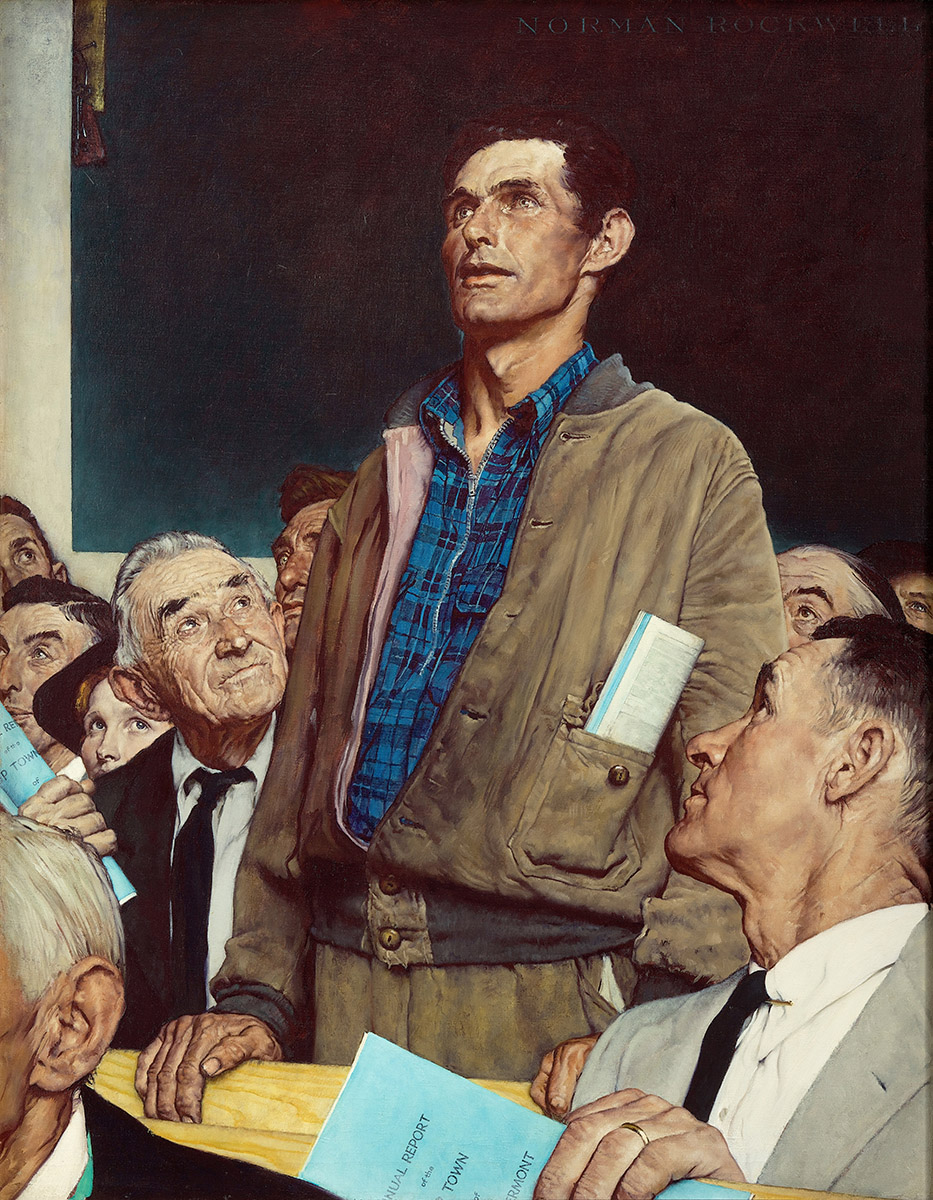
Freedom of Speech
Illustration for The Saturday Evening Post, February 21, 1943
Oil on canvas
By Norman Rockwell
Norman Rockwell Museum Collection
© 1943 SEPS – Curtis Publishing
Narrated By:
Brian Allen
American Art Scholar
In the case of Freedom of Speech, it’s one of the few pictures that Rockwell did that was based on something that really happened.
Arlington had a high school that was built in the 1920s, and in 1940 there was a fire, and the high school burned down. So there was immediately a need in town to decide whether to build a new high school, whether to send kids to neighboring towns for high school. So there was a movement in town to appropriate money to build a new high school and that required the approval of the town meeting.
Most towns in Vermont, most towns in New England, the town meeting form of government invests in every voter, every property owner the role of legislator. Every voter has the right to come to the town meeting and vote on the appropriation of money, in this case for the high school.
Jim Edgerton who was a farmer in town, he got up at the town meeting, and he spoke against the effort to spend money to build a new high school. It was during the depression, the price of commodities had plummeted and he paid his bills every month by selling milk. He wasn’t poor, but he was feeling a pinch as everybody was during the depression in Vermont. And that lead him to be very conscious of higher taxes.
The instant that Rockwell picked was that moment where Edgerton was saying what he thought, and people were listening to him—other voters, other legislators listening to him respectfully.
Even though Jim Edgerton was the one who was actually speaking, he wasn’t the type that Rockwell was looking to underscore the themes of each person having an independent vote and voice at the town meeting. He was looking for someone who looked like Abe Lincoln, and that’s what he was after. He was looking for an everyman. And so he used Carl Hess as the model, and Carl Hess ran a gas station in town; he just had the look that Rockwell was after.
Spanish
Freedom of Speech (Libertad de expression)
Ilustración para The Saturday Evening Post, 21 de febrero de 1943
Óleo sobre lienzo
Por Norman Rockwell
Colección del Museo Norman Rockwell
© 1943 SEPS – Curtis Publishing
Narrado por:
Brian Allen
Erudito de arte americano
En el caso de Freedom of Speech, es una de las pocas imágenes que Rockwell hizo que se basó en algo que realmente sucedió.
Arlington tenía una escuela secundaria que se construyó en la década de 1920, y en 1940 hubo un incendio, y la escuela secundaria se quemó. Así que inmediatamente hubo una necesidad en la ciudad de decidir si se debería construir una nueva escuela secundaria o enviar a los niños para las escuelas secundarias de las ciudades vecinas. Entonces hubo un movimiento en la ciudad para destinar dinero para construir una nueva escuela secundaria y eso requirió la aprobación en asamblea popular.
La mayoría de las ciudades de Vermont, la mayoría de las ciudades de Nueva Inglaterra, la forma de gobierno de asamblea popular invierte en cada votante, cada propietario tiene el papel de legislador. Cada votante tiene el derecho de asistir a la asamblea popular y votar sobre la destinación del dinero, en este caso para la escuela secundaria.
Jim Edgerton, que era agricultor en la ciudad, se levantó en la asamblea popular y habló en contra del esfuerzo por gastar dinero para construir una nueva escuela secundaria. Fue durante la Depresión, el precio de las materias primas se había desplomado y él pagaba sus cuentas todos los meses vendiendo leche. Él no era pobre, pero estaba sintiendo un pellizco como todos durante la Depresión en Vermont. Y eso lo llevó a ser muy consciente de impuestos más altos.
Rockwell eligió el momento cuando Edgerton decía lo que pensaba, y la gente lo escuchaba: otros votantes, otros legisladores que lo escuchaban con respeto.
A pesar de que Jim Edgerton fue quien realmente estaba hablando, él no era del tipo que Rockwell buscaba subrayar los temas de cada persona que tiene un voto independiente y voz en la asamblea popular. Estaba buscando a alguien que se pareciera a Abe Lincoln, y eso es lo que él buscaba. Él estaba buscando un hombre común. Y entonces usó a Carl Hess como modelo, y Carl Hess tenía una gasolinera en la ciudad; tenía el aspecto que Rockwell buscaba.
French
Liberté d’Expression
Illustration pour le Saturday Evening Post, 21 février 1943
Huile sur toile
Par Norman Rockwell
Collection du Musée Norman Rockwell
© 1943 SEPS – Éditions Curtis
Raconté Par :
Brian Allen
Chercheur d’Art Américain
Dans le cas de la liberté d’expression, c’est l’une des rares images que Rockwell a fait qui était basée sur quelque chose qui s’est réellement passé.
Il y avait un lycée à Arlington qui a été construite dans les années 1920, et en 1940, il y avait un incendie, et l’école secondaire a brûlé. Donc, il y avait un besoin immédiat dans la ville de décider s’il fallait construire un nouveau lycée, s’il fallait envoyer les enfants dans les villes voisines pour le lycée. Il y avait donc un mouvement en ville pour trouver de l’argent pour construire un nouveau lycée et cela nécessitait l’approbation de la réunion du conseil municipal.
La plupart des villes du Vermont, la plupart des villes de la Nouvelle-Angleterre, la forme de gouvernement par réunion du conseil municipal, investit le rôle de législateur dans chaque électeur, chaque propriétaire. Chaque électeur a le droit de venir à la réunion du conseil municipale et voter sur l’appropriation de l’argent, dans ce cas pour le lycée.
Jim Edgerton, qui était un fermier dans la ville, s’est levé à la réunion municipale, et il a pris la parole contre l’effort de dépenser de l’argent pour construire un nouveau lycée. C’était pendant la dépression, le prix des marchandises avait chuté et il payait ses factures tous les mois en vendant du lait. Il n’était pas pauvre, mais il ressentait la pincée comme tout le monde pendant la dépression au Vermont. Et cela l’a rendu très conscient des taxes plus élevées.
L’instant que Rockwell a choisi était ce moment où Edgerton disait ce qu’il pensait, et les gens l’écoutaient – d’autres électeurs, d’autres législateurs l’écoutaient respectueusement.
Même si Jim Edgerton était celui qui parlait réellement, il n’était pas le genre que Rockwell cherchait pour souligner les thèmes de chaque personne ayant un vote indépendant et une voix à la réunion municipale. Il cherchait quelqu’un qui ressemblait à Abe Lincoln, et c’est ce qu’il recherchait. Il cherchait un homme ordinaire. Alors il a utilisé Carl Hess comme modèle et Carl Hess dirigeait une station-service dans la ville ; il avait juste l’air que Rockwell était recherchait.
German
Freedom of Speech (Freiheit der Rede)
Illustration für The Saturday Evening Post, 21. Februar 1943
Öl auf Leinwand
Von Norman Rockwell
Norman Rockwell Museumssammlung
© 1943 SEPS – Curtis Publishing
Erzählt von:
Brian Allen
Amerikanischer Kunstgelehrter
Bei Freedom of Speech handelt es sich um eines der wenigen von Rockwell gemalten Bilder, die auf einer wahren Begebenheit beruhen.
Arlington hatte eine Sekundarschule, die in den 1920er-Jahren gebaut wurde und 1940 einem Brand zum Opfer fiel. Die Stadt sah sich schlagartig vor die Aufgabe gestellt, zu entscheiden, ob man eine neue Sekundarschule bauen oder die Kinder in die Sekundarschulen der umliegenden Städte schicken sollte. Es gab eine Gesinnungsgemeinschaft in der Stadt, die Gelder für die Errichtung einer neuen Sekundarschule bereitstellen wollte, und dazu war die Genehmigung der Bürgerversammlung erforderlich.
In den meisten Städten Vermonts, wie auch in den meisten Städten der übrigen Neuenglandstaaten, kommt jedem Stimmberechtigten, jedem Grundstückseigentümer eine gesetzgebende Funktion in der Bürgerversammlung als Stadtregierung zu. Jeder Stimmberechtigte hat das Recht, zur Bürgerversammlung zu kommen und über die Bereitstellung von Geldern abzustimmen – in diesem Fall für die Sekundarschule.
Jim Edgerton, ein ortsansässiger Landwirt, erhob sich bei der Bürgerversammlung und sprach sich gegen das Vorhaben, Geld für den Bau einer neuen Sekundarschule auszugeben, aus. Man befand sich gerade in der Wirtschaftskrise, die Rohstoffpreise waren im Keller, und Jim Edgerton kam für seine monatlich anfallenden Rechnungen auf, indem er Milch verkaufte. Er war zwar nicht arm, spürte jedoch den Druck wie jeder andere auch während der Wirtschaftskrise in Vermont. Und deshalb reagierte er auf höhere Steuern äußerst empfindlich.
Der Augenblick, den Rockwell sich ausgesucht hat, war jener Moment, als Edgerton gerade sagte, was er dachte und die Leute ihm zuhörten – andere Stimmberechtige, andere Gesetzgeber, die ihm respektvoll lauschten.
Auch wenn es Jim Edgerton war, der tatsächlich sprach, war er nicht der Typ, nach dem Rockwell eigentlich suchte, um die Themen der einzelnen Personen, die über ein unabhängiges Stimmrecht und eine Stimme in der Bürgerversammlung verfügten, hervorzuheben. Tatsächlich war er darauf aus, jemanden zu finden, der aussah wie Abraham Lincoln. Er war auf der Suche nach einem Allerweltsgesicht. Und so zog er Carl Hess als Modell heran, der eine Tankstelle in der Stadt führte; Carl Hess besaß nämlich genau jenes Aussehen, nach dem Rockwell auf der Suche gewesen war.
Japanese
Freedom of Speech
言論の自由
Illustration for The Saturday Evening Post, February 21, 1943
1943年2月21日サタデイイブニングポストのイラスト
Oil on canvasオイルキャンバス
By Norman Rockwell
ノーマン・ロックウェル作
Norman Rockwell Museum Collection
ノーマンロックウェルミュージアムコレクション
© 1943 SEPS – Curtis Publishing
©1943 SEPS -カーティス出版
Narrated By: Brian Allen
American Art Scholar
ブライアンアレンによるナレーション付き
アメリカ美術学者
In the case of Freedom of Speech, it’s one of the few pictures that Rockwell did that was based on something that really happened.
「言論の自由」の場合、それはロックウェルが実際に起こった出来事に基づいて描いた数少ない絵の一つです。
Arlington had a high school that was built in the 1920s, and in 1940 there was a fire, and the high school burned down.
アーリントンには、1920年代に建設された高校がありましたが、1940年に火事があり、同高校は焼失してしまいました。
So there was immediately a need in town to decide whether to build a new high school, whether to send kids to neighboring towns for high school.
ですから、新しい高校を作るか、生徒たちを近くの町に通わせるかどうかをすぐに決める必要がありました。
So there was a movement in town to appropriate money to build a new high school and that required the approval of the town meeting.
そのため、新しい高校を建設するためのお金を調達するための運動があり、それはタウンミーティングの承認を必要としました。
Most towns in Vermont, most towns in New England, the town meeting form of government invests in every voter, every property owner the role of legislator.
バーモント州のほとんどの町、ニューイングランドのほとんどの町、すべての有権者に政府のタウンミーティング用紙が配られ、すべての財産所有者が議員の役割を果たします。
Every voter has the right to come to the town meeting and vote on the appropriation of money, in this case for the high school.
すべての有権者は、タウンミーティングに出席しーこのケースでは高校のためにー、お金の使途について投票する権利を持っています。
Jim Edgerton who was a farmer in town, he got up at the town meeting, and he spoke against the effort to spend money to build a new high school.
町の農夫であったジムエッゲートンはタウンミーティングに出席し、新しい高校を建設するためにお金を使うことに反対しました。
It was during the depression, the price of commodities had plummeted and he paid his bills every month by selling milk.
それは不況の間、商品の価格が急落したため、彼は毎月牛乳を売って請求書の支払いをしていたからです。
He wasn’t poor, but he was feeling a pinch as everybody was during the depression in Vermont.
彼は貧乏人ではありませんでしたが、バーモント州の不況の間に誰もが実感したように、彼はピンチを感じていました。
And that lead him to be very conscious of higher taxes.
ですから彼は税金が上がることを非常に意識するようになりました。
The instant that Rockwell picked was that moment where Edgerton was saying what he thought, and people were listening to him—other voters, other legislators listening to him respectfully.
ロックウェルが選んだ瞬間は、エッゲートンが彼が思ったことを言っている間、人々が彼の話を聞いている- 他の有権者や他の議員が彼を尊重して聞いている-瞬間でした。
Even though Jim Edgerton was the one who was actually speaking, he wasn’t the type that Rockwell was looking to underscore the themes of each person having an independent vote and voice at the town meeting.
実際に話していたのはジムエッゲートンでしたが、タウンミーティングで独立した投票と意見を持つ各人のテーマを強調するためにロックウェルが探していたタイプではありませんでした。
He was looking for someone who looked like Abe Lincoln, and that’s what he was after.
彼は、リンカーンのように見える人を探していて、後で実際にそうしました。
He was looking for an everyman.
彼は普通の人を探していました。
And so he used Carl Hess as the model, and Carl Hess ran a gas station in town; he just had the look that Rockwell was after.
そして彼はモデルとしてカールヘスを使い、カールヘスは町のガソリンスタンドを開業しました。彼はちょうどロックウェルが後になって使っているルックスを持っていました。
Chinese
言论自由
《星期六晚报》插画,1943年2月21日
布面油画
创作者/诺曼·洛克威尔
诺曼·洛克威尔博物馆收藏
© 1943 SEPS – Curtis Publishing
讲述人:
Brian Allen
美国艺术学者
《言论自由》是洛克威尔为数不多的几幅根据真实发生的事件创作的作品之一。
阿灵顿原本有一所20世纪20年代创立的高中,但1940年的一场大火将它烧毁。因此,小镇需要立即决定是再新建一所高中,还是选择把孩子们送到邻镇上学。于是,小镇发起了一项为新建高中筹集资金的活动,而这一行为需要通过镇上选民大会的批准。
在佛蒙特州和新英格兰地区的大部分城镇中,镇政府会议会赋予每个人投票权,每一位业主都是立法者。每位选民都有权利出席选民大会并投票决定拨款额,这次的拨款对象是高中。
吉姆·埃杰顿(Jim Edgerton)是镇上的一位农场主,他在会上站起来反对花钱新建高中的做法。当时正值大萧条时期,商品价格暴跌,他每个月要靠卖牛奶支付各项账单。他其实并不穷,但佛蒙特州的大萧条让他和其它所有人一样,倍感沮丧。因此,他对提高税收的问题十分敏感。
洛克威尔选取的场景就是埃杰顿说出自己想法的那一刻,大家都在认真听他讲话——其它选民、其他立法者都在认真聆听他的意见,礼貌而尊重。
虽然吉姆·埃杰顿才是真正站起来讲话的人,但他却并不是洛克威尔想要突出每个人在选民大会上都有独立投票权和话语权这一主题的典型人物。洛克威尔想要的是如林肯一般的人,这才是他追求的。他要的是一个普普通通的人。所以,他将卡尔·赫斯(Carl Hess)——镇上加油站的老板——作为典型;他的长相正是洛克威尔寻求的样子。
Arabic
حرية التعبير
صورة لجريدة “ساترداي إيفنينغ بوست”، 21 فبراي1943
رسم زيتي على قماش
لـ نورمان روكويل
مجموعة متحف نورمان روكويل
© 1943 SEPS – كورتيس للنشر
الراوي:
برايان آلان
باحث في الفنّ الأمريكي
بالنسبة لـ “حريّة التعبير”، تُعتبر إحدى الصور القليلة التي أنجزها روكويل وكانت مبنيّة على شيء حدث فعلا.
كانت توجد في مقاطعة أرلينغتون مدرسة ثانوية بُنيت في عشرينات القرن الماضي، وفي سنة 1940 نشب حريق أتى على المدرسة الثانوية. لهذا كانت هنالك حاجة ملحّة في المدينة لاتخاذ قرار ببناء مدرسة ثانوية جديدة أو ارسال الأطفال إلى المدن المجاورة للالتحاق بمدارسها الثانوية. لهذا كان هنالك نشاط في المدينة من أجل تخصيص المال لبناء مدرسة ثانوية جديدة، ولقد تطلّب ذلك موافقة جمعية المدينة.
بمشاركة أغلب المدن في فيرمونت وأغلب المدن في نيو إنجلند، يستثمر شكل الحكم المتمثل في جمعية المدينة في كلّ صاحب صوت، ويلعب كل ذي ملكية دور المشرِّع. يملك كلّ مصوّت الحق في القدوم إلى جمعية المدينة والتصويت على تخصيص المال، وفي هذه الحالة، تخصيصه لبناء مدرسة ثانوية.
شارك “جيم إدجرتون”، الذي كان مزارعا في المدينة، في الجمعية وكان كلامه معارضا للجهود الرامية لبناء مدرسة ثانوية جديدة. كان ذلك خلال فترة الكساد التي شهدت انخفاضا في سعر السلع، وكان يدفع فواتيره كلّ شهر من خلال بيع الحليب. لم يكن فقيرا، لكنه كان يشعر بضيق الحال كغيره أثناء فترة الكساد في فيرمونت. قاده ذلك إلى أن يكون قلقا بشأن الزيادة في الضرائب.
اللقطة التي اختارها روكويل كانت لحظة تعبير إدجرتون عمّا يجول في خاطره، وكان الناس يصغون إليه – غيره من المصوّتين والمشرّعين كانوا يصغون إليه بكلّ احترام.
على الرغم من أنّ “جيم إدجرتون” كان هو المتحدث فعلا، إلّا أنه لم يكن الشخص الذي يبحث عنه روكويل لتجسيد فكرة أنّ لكلّ شخص صوتا مستقلّا في جمعية المدينة. لقد كان يبحث عن شخص يشبه أبراهام لينكولن، ذلك ما كان يسعى وراءه. كان يبحث عن رجل جدّ اعتيادي. لهذا استخدم “كارل هيس” كنموذج، وكان هذا الأخير يدير محطة بنزين في المدينة، وقد تمتّع بالشكل الذي كان يبحث روكويل عنه.