
English
Norman Rockwell 1894–1978
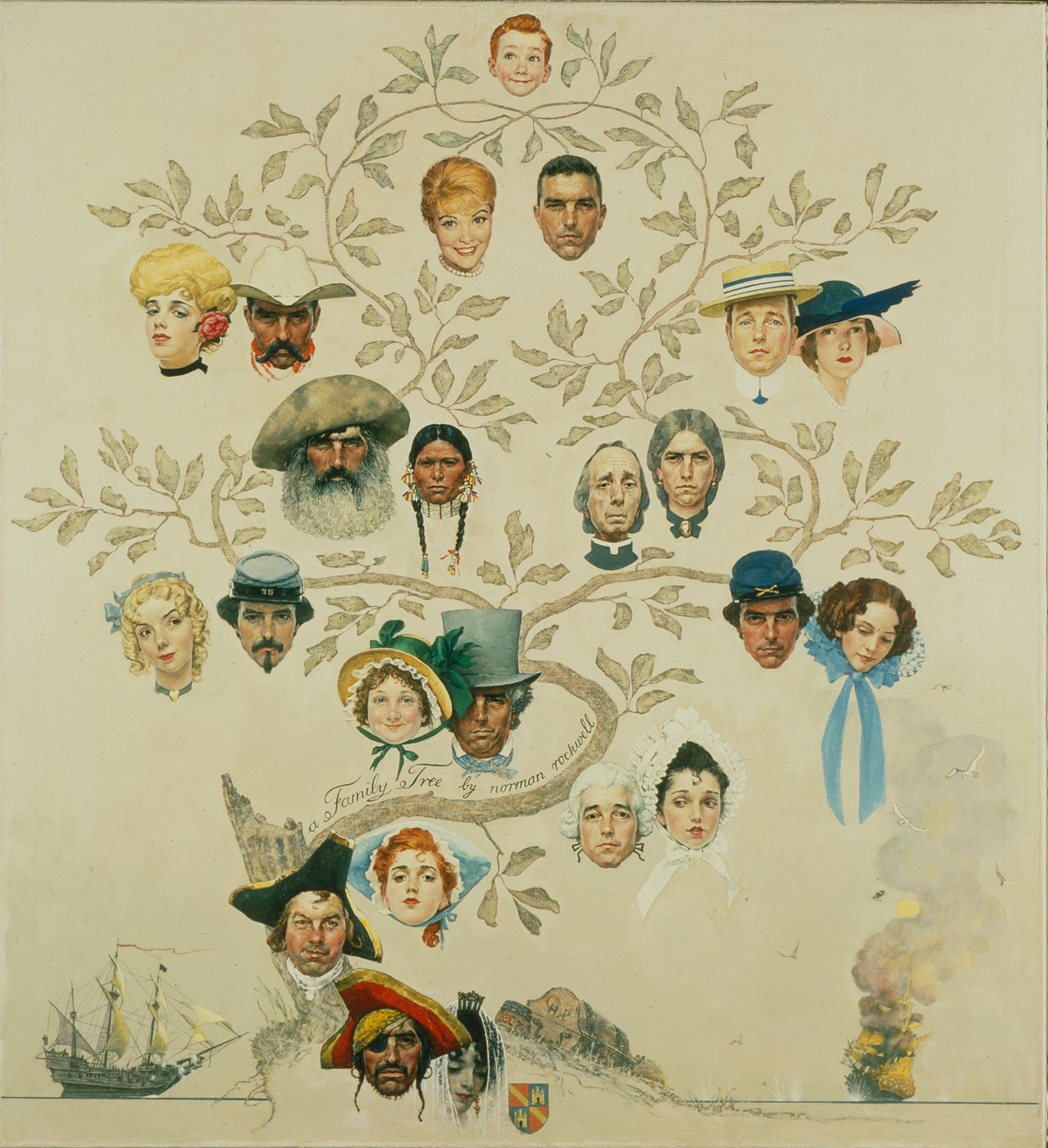
Family Tree, 1959
Cover illustration for The Saturday Evening Post cover, October 24, 1959
Oil on canvas
Norman Rockwell Museum Collection, Norman Rockwell Art Collection Trust, NRACT.1973.7
Norman Rockwell in his own Words – AUDIO TRANSCRIPT
Well here it is, 8:00 Sunday morning, August 2nd. Yesterday, I worked all day on The Family Tree. The day before I’d done the little boy and his father at the top. Yesterday morning I did the mother and the Indian, who turned out pretty good. I did that in about two hours, and I think the girl looks pretty good, too.
I think the whole thing is, I get these done, it’s going to be tough for this. After all, I’ve only done about a little over six of them in two days, but that would be 12 more days if I work at the same rate on the cover. Plus there’s also touching up the ship, and the tree, and whatnot. But I think another 12 days, barring the interruptions of doing other work, I think we’ll take care of it. So there’s no doubt in the world that we’ll have it done by September 1st.
Got out Arthur Rackham’s book, Swipe the Roots of the Tree, which I’ll use later. I definitely feel I’ll make the ships bigger. They’re a little tiny in the whole composition. And went all over the picture. Put the red bandana, or the effect of red onto the son of the Indian. Brightened up the color on the 1920 girl’s hat, underneath her hat. Brightened the green on top. Put a green bow on the westerner’s blonde girlfriend’s head.
Oh, and I fooled all around. I think I got it going much, much more exciting now. I wish I knew, there must be some easier way than painting pictures like this, but I don’t know what it is. And then I’m always come up with the idea that these ones I have the most trouble with are always my best pictures.
Adult Audio Tour – Part 2
[NARRATOR] The week of October 24th, 1959, Post readers were greeted by this family tree that’s a trip through American History. Start down at the bottom. At the root are a swarthy pirate and his bashful Spanish senora. The generations move up, past the colonial era, where they’re split by the Civil War. On the left, the Southern branch proceeds up through frontier days and the Wild West. On the right, the Northern branch zigzags from conservative New England into the roaring ‘20s. Perched on top — the culmination of the centuries — a cheery boy.
If you’ve noticed a family resemblance, there’s a good reason. My father used the same model for each of the men in the family.
[DOLSON] I’m Frank Dolson, and I modeled for Norman Rockwell, and I’m proud of it. You’ll notice that I have a rather large bridge at the top of my nose. Kind of a wide space there, and he made sure that that particular feature carried through in each generation.
Probably the one that looks most like I did at the time is that next-to-the-last generation, where the gal has slightly red hair and I have jet-black hair which I did have, once. (laughs)
[PETER ROCKWELL] Frank Dolson actually modeled for every man here–but one. See if you can find him. The mournful-looking preacher near the middle is my father.
[DOLSON] He put himself in there and painted himself as a preacher, and made me — his wife!
Family
Norman Rockwell 1894–1978
Family Tree, 1959
Cover illustration for The Saturday Evening Post cover, October 24, 1959
Oil on canvas
Norman Rockwell Museum Collection, Norman Rockwell Art Collection Trust, NRACT.1973.7
Family Audio Tour
[NORMAN ROCKWELL CHARACTER] This is a family tree. Look up at the very top for the little red-headed fella.
[NORMAN ROCKWELL CHARACTER] Being at the top of the tree, all the folks underneath are his relatives. Let’s go back in time and see who they are. Go all the way down to the very bottom.
[NORMAN ROCKWELL CHARACTER] His great, great, great, great, great, great grandparents are a pirate and a Spanish senora.
[NORMAN ROCKWELL CHARACTER] Now, follow the trunk of the tree back up as it goes up through time.
[NORMAN ROCKWELL CHARACTER] And we’re back at the top again.
[NORMAN ROCKWELL CHARACTER] But let me show you something else. Go back to the pirate.
[NORMAN ROCKWELL CHARACTER] Look carefully at all the faces of the men in the family tree.
[NORMAN ROCKWELL CHARACTER] Notice something familiar about them? They’re really all the same guy. I used a neighbor of mine–Frank–as the model for all the men in the family. Look at the top of his nose–see how it’s kind of flat? It’s the same in every man. Except one. Find him yet?
[NORMAN ROCKWELL CHARACTER] Look in the middle, on the right side. The preacher?–that’s me. And the preacher’s wife? That’s Frank.
Spanish
Norman Rockwell 1894–1978
Árbol genealógico, 1959
Ilustración de portada para *The Saturday Evening Post*, 24 de octubre de 1959
Óleo sobre lienzo
Colección del Museo Norman Rockwell, Norman Rockwell Art Collection Trust, NRACT.1973.7
Norman Rockwell en sus propias palabras – TRANSCRIPCIÓN DE AUDIO
Pues aquí está, a las 8:00 de la mañana del domingo 2 de agosto. Ayer trabajé todo el día en The Family Tree. El día anterior había acabado con el niño pequeño y su padre en la cima. Ayer por la mañana hice lo de la madre y el indio, que resultaron bastante buenos. Lo hice en unas dos horas, y creo que la chica también se ve muy bien.
Creo que todo el asunto es que, si hago esto, va a ser difícil para esto. Después de todo, solo he hecho un poco más de seis en dos días, pero serían 12 días más si trabajo a la misma velocidad en la portada. Además, también hay que retocar la nave, el árbol y demás. Pero creo que otros 12 días, salvo las interrupciones de hacer otro trabajo, creo que nos ocuparemos de ello. Así que no hay duda en el mundo de que lo habremos hecho antes del 1 de septiembre.
Saqué el libro de Arthur Rackham, Swipe the Roots of the Tree, que usaré más adelante. Definitivamente creo que voy a hacer que los barcos sean más grandes. Son un poco pequeños en toda la composición. Y salí por toda la imagen. Ponga el pañuelo rojo, o el efecto del rojo, en el hijo del indio. Iluminó el color del sombrero de la chica de 1920, debajo de su sombrero. Ilumina el verde en la parte superior. Pon un lazo verde en la cabeza de la novia rubia del occidental.
Oh, y he engañado a todos lados. Creo que lo he puesto en marcha mucho, mucho más excitante ahora. Ojalá lo supiera, debe haber una manera más fácil que pintar cuadros como este, pero no sé qué es. Y luego siempre se me ocurre la idea de que esas con las que tengo más problemas son siempre mis mejores imágenes.
Spanish Adult Audio Tour – Part 2
Peter Rockwell: La semana del 24 de octubre de 1959, los lectores del Postpudieron admirar en su portada este árbol genealógico, el cual constituye un recorrido a través de la historia de los Estados Unidos. Empecemos e la parte de abajo. En la raíz vemos a un pirata de tez morena y a su tímida mujer. Las generaciones ascienden por el árbol, pasando por la era colonial, en donde se ven divididas por la Guerra Civil.
A la izquierda la rama del sur continúa creciendo hacia los días de la colonización y del viejo oeste. A la derecha, la rama del norte zigzaguea desde una conservadora Nueva Inglaterra hasta los turbulentos 20s. Trepado en la copa del árbol, tenemos la culminación del paso de los siglos, el optimista rostro de un chico. Si percibe cierto parecido familiar, tiene buenas razones para serlo. Mi padre utilizó al mismo modelo al pintar todos hombres de la familia.
Frank Dolson: Mi nombre es Frank Dolson, fui modelo de Norman Rockwell y estoy muy orgulloso de haberlo sido. Como puede ver, el cuento de la parte superior de mi nariz es muy largo, bastante espaciado. Rockwell se aseguró de que ese rasgo particular fuera pasado de generación en generación. Es probable que el retrato que más se parezca a la manera en que yo lucía en esa época, sea el de la penúltima generación, en el que la dama tiene el cabello ligeramente rojizo y yo tengo el cabello negro azabache, como alguna vez lo tuve.
Peter Rockwell: En realidad, Frank Dolson modeló para el retrato de todos los hombres, excepto uno. Vea si puede encontrarlo. El predicador de aspecto apesadumbrado, cerca del centro, es mi padre.
Frank Dolson: Se incluyó en este cuadro y se representó como predicador. A mí me convirtió en su esposa.
Spanish Family
Norman Rockwell 1894–1978
Árbol genealógico, 1959
Ilustración de portada para *The Saturday Evening Post*, 24 de octubre de 1959
Óleo sobre lienzo
Colección del Museo Norman Rockwell, Norman Rockwell Art Collection Trust, NRACT.1973.7
Spanish Family Audio Tour
[música]
Norman Rockwell: Este es un árbol genealógico. Mira hasta arriba y busca al muchacho pelirrojo. Como está en la parte más alta del árbol, esto quiere decir que las personas debajo de él son sus familiares. Viajemos al pasado y empecemos en la parte de hasta abajo.[sonido de descenso]
Norman Rockwell: Sus más antiguos familiares son un pirata y su esposa española. Ahora sigue el tronco del árbol para arriba a medida que pasan los años.[música]
Norman Rockwell: Y estamos de vuelta a la parte de arriba. Pero permíteme mostrarte otra cosa. Vayamos de regreso con el pirata.
[sonido de descenso]
Norman Rockwell: Observa detenidamente todas las caras de los hombres de este árbol genealógico. ¿Notas algo común entre ellos? En realidad todos son el mismo señor. Usé a un vecino, Frank, como modelo de todos los hombres de la familia. Si ves la parte de arriba de su nariz, verás que es un poco plana. Se trata de la misma persona, excepto una. ¿La puedes encontrar?[campanadas]