
English
Norman Rockwell
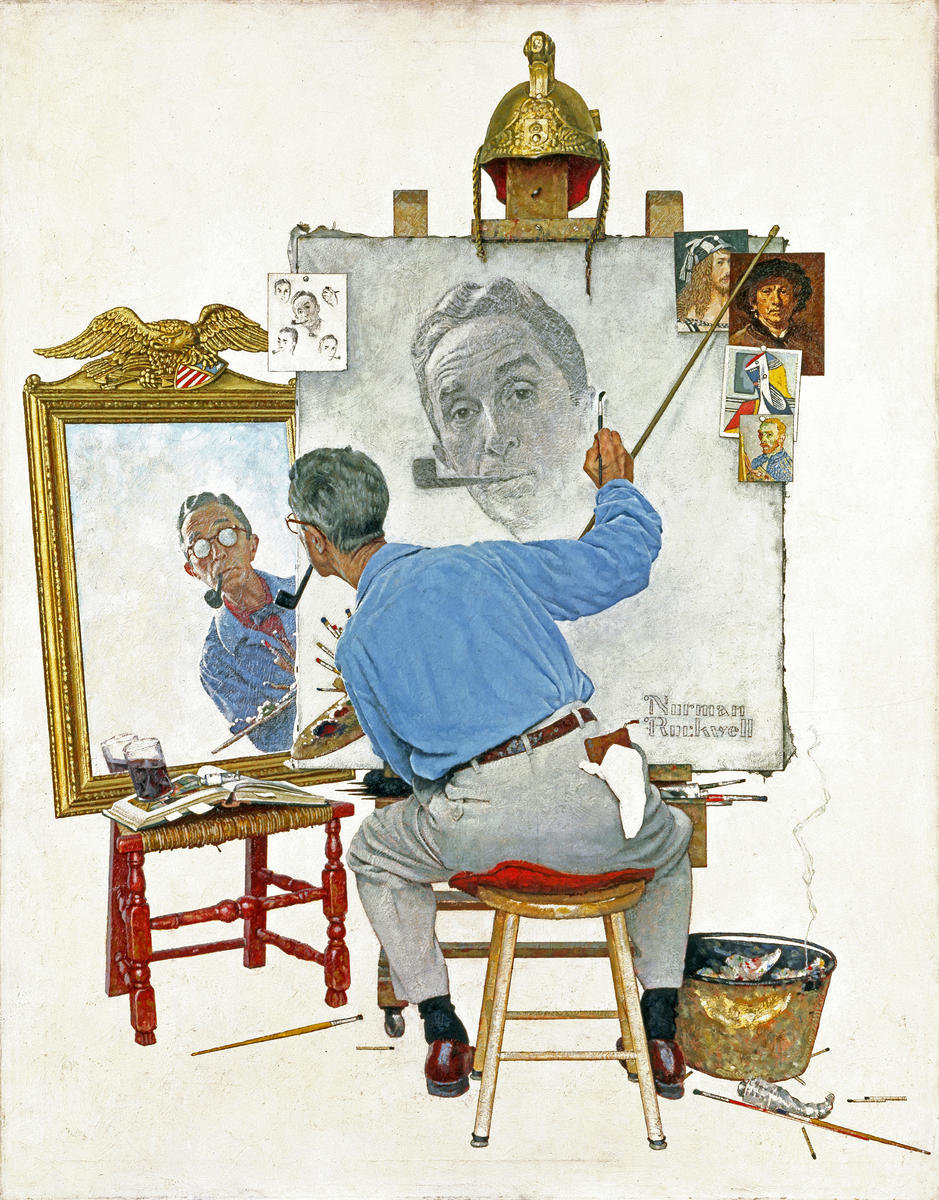
Triple Self Portrait, c. 1959
Cover illustration for The Saturday Evening Post (February 13, 1960)
Oil on canvas
[ROCKWELL/ART COLLEGE ADDRESS] He said, “You’re Norman Rockwell, aren’t you?” And of course I was just tickled to death that they recognized me (laughs)
[PETER ROCKWELL] My father painted himself for the cover of the Saturday Evening Post in 1960. Tacked up on his easel as reference are other self-portraits: There’s Dürer, Rembrandt, Picasso and Van Gogh.
My father called this picture “Triple Self-Portrait.” First, there’s the artist himself sitting on the stool; then there’s his reflection in the mirror; and third, the image he’s painting on the canvas.
Deputy Director/Chief Curator, Stephanie Plunkett:
[STEPHANIE PLUNKETT] But you immediately notice that that likeness is somewhat different from the Rockwell who’s glancing into the mirror, who appears somewhat older, whose glasses are clouded, and … whose pipe is hanging down at a little bit less level than the perky pipe that we see in the drawing on the canvas. …. I think one of the wonderful things about this portrait is that it really gives … a sense of the inner and outer lives of the artist
[ROCKWELL/ART COLLEGE ADDRESS 1949] I love to tell stories in pictures, … I don’t care whether It’s art or not, see? [Laughter]
[PETER ROCKWELL] My father included many personal details in this picture.
Family
Norman Rockwell
Triple Self Portrait, c. 1959
Cover illustration for The Saturday Evening Post (February 13, 1960)
Oil on canvas
[NORMAN ROCKWELL CHARACTER] This is me. Norman Rockwell. Lots of me, really. You’ve got: The back of me.The me looking out of the mirror The me in the painting I’m working on, and few more little me’s in that pencil sketch tacked up on the left corner. I’m an illustrator. That means I make pictures for a living–pictures that tell stories.
See the stick under my hand? That’s called a “malhstick.” I lean on it to steady my hand when painting in fine details. Look in the bottom corner of the painting I’m working on. You can see my signature.
When I was a kid my friends called me “Mooney,” ‘cause I wore round glasses. You can see I’m still wearing them here, a long time later. I never wanted to be anything but an artist, even when I was a kid. It was just one of those things. My friend George could wiggle his ears. I could draw.
Look in the right corner of the painting, for the bucket full of rags. Did you notice there’s a little smoke coming out? A few years back, my studio caught fire and burned down. Nobody was hurt, but lots of my stuff went up in flames. So I put that in here as a reminder, a little joke, just for me.
Remember my handsome face, because you might see it again.
Spanish
Norman Rockwell
Triple Self Portrait, c. 1959
Cover illustration for the Saturday Evening Post (February 13, 1960)
Oil on canvas
Norman Rockwell: [inglés] He said, “You’re Norman Rockwell, aren’t you?”
Él dijo “Usted es Norman Rockwell ¿cierto?”, y por supuesto me dió mucho gusto que me reconocieran.
Narrador: Mi padre se pintó a sí mismo para la portada del [inglés] Saturday Evening Post en 1960. Clavados en su caballete como referencia incluyó otros autorretratos, los de Dürer, Rembrandt, Picasso, y Van Gogh. Mi padre llamó a esta obra Autorretrato Triple. Primero está el propio artista sentado en un banco, luego tenemos su reflejo en el espejo, y finalmente aparece en la imagen que está pintando en el lienzo. Nos habla la curadora Stephanie Plunkett.
Stephanie Plunkett: [inglés] But you immediately notice that that likeness is– Pero de inmediato nos damos cuenta de que la apariencia del rostro del cuadro es un poco diferente a la cara que se refleja en el espejo, la cual se ve más avejentada, usa anteojos opacos, y lleva una pipa colgando de la boca a un ángulo más bajo y casual que la imagen del lienzo. Creo que una de las cosas más maravillosas que nos brinda este retrato es el sentido de la vida interna diferente al de la vida externa del artista.
Norman Rockwell: [inglés] I love to tell stories in pictures–
Me encanta contar historias en mis cuadros. No me importa si es arte o no lo es, ¿ven?Narrador: Mi padre incorporó múltiples detalles personales en esta obra.
Spanish Family
Norman Rockwell
Triple Self Portrait, c. 1959
Cover illustration for the Saturday Evening Post (February 13, 1960)
Oil on canvas
Norman Rockwell: Este soy yo, Norman Rockwell. De hecho soy yo varias veces. Tenemos: mi espalda, yo reflejado en el espejo, yo en la pintura que estoy pintando, y otros pequeños yos en el boceto a lápiz pegado en la esquina izquierda de arriba. Soy ilustrador, lo que quiere decir que me gano la vida haciendo retratos — pinturas que relatan una historia.
¿Ves la vara que tengo bajo la mano? Sirve para darle estabilidad a mi mano cuando pinto detalles muy finos. Mira la esquina de abajo del cuadro que estoy pintando — tiene mi firma. Cuando era niño mis amigos me llamaban Mooney, porque en inglés luna se dice [inglés] moon, y yo usaba lentes redondos como la luna. En este cuadro puedes ver que sigo usándolos mucho tiempo después.
No quería ser otra cosa más que artista, incluso desde que era muy chico. Era una de esas cosas que yo podía hacer. Mi amigo George podía mover las orejas, yo podía dibujar.
En la esquina derecha de la pintura hay una cubeta llena de trapos. ¿Puedes ver que de ella sale un poco de humo? Unos años antes mi estudio se incendió. Nadie salió lastimado, pero muchas de mis cosas se convirtieron en cenizas, así que decidí poner esta cubeta como recordatorio, una pequeña broma solo para mí. No te olvides de mi apuesto rostro, pues podrías verlo de nuevo.