
English – Family
Norman Rockwell
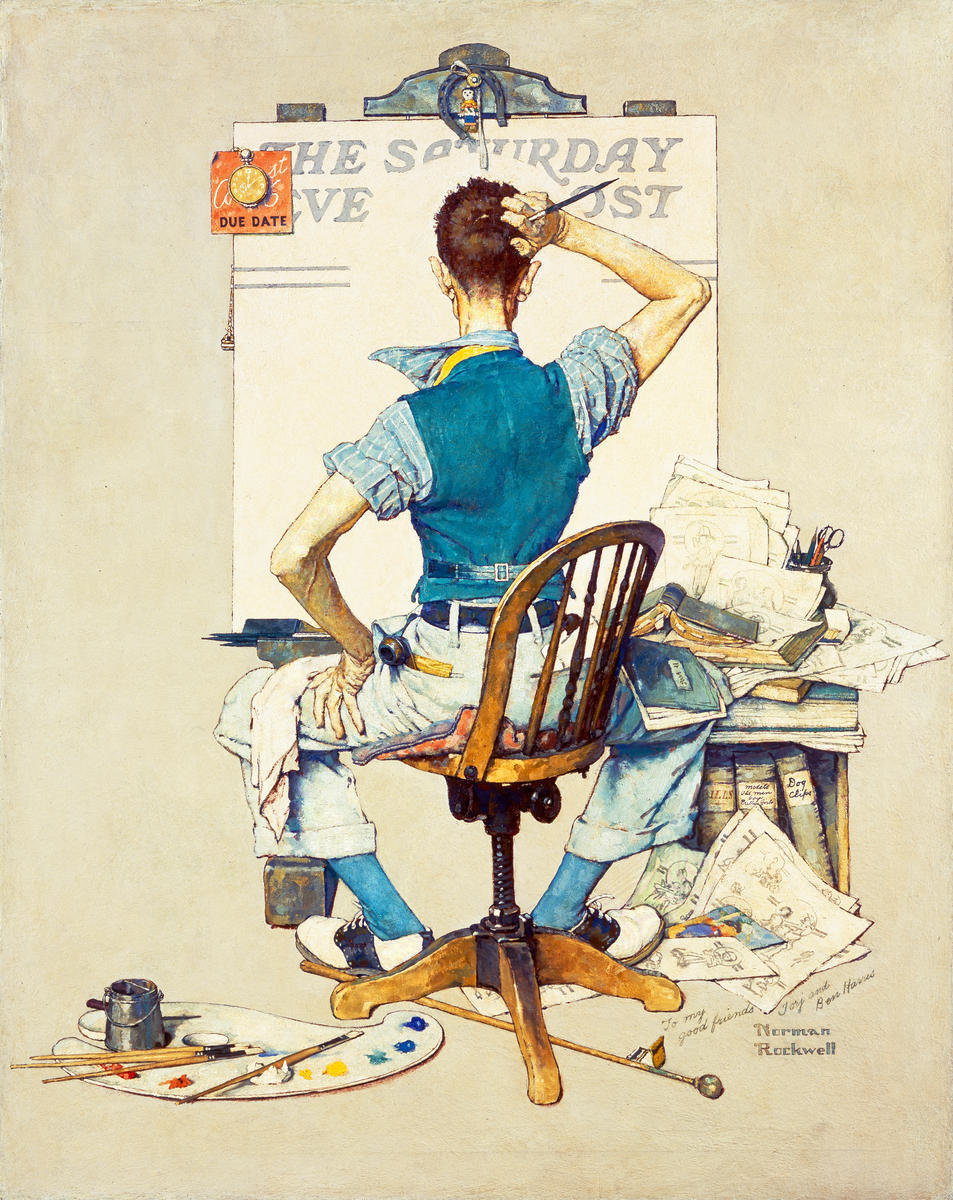
Deadline (Artist Facing Blank Canvas). 1938
Cover illustration for The Saturday Evening Post, October 8, 1938
Oil on canvas
Norman Rockwell Museum Collection
© 1938 SEPS – Curtis Publishing
Adult Audio Tour
PETER ROCKWELL: In 1938, my father solved the problem of being stumped for a cover idea by painting an illustrator stumped for a cover idea.
LAURIE NORTON MOFFATT: Everything in the painting suggests that this is Norman Rockwell himself, and the struggle that he had to constantly come up with ideas. …. sketch after sketch tossed aside on the floor, … we see the palette …. tossed aside with brushes, many colors put out, all the artist’s tools.
PETER ROCKWELL: Look at the top of the artist’s canvas, above his head. His good luck charms have had no effect. The canvas is still blank.
LAURIE NORTON MOFFATT: And of course the great pun in this is the artist facing the blank canvas …. actually becomes the image of this painting.
PETER ROCKWELL: The irony here is that my father never would have sat down at a blank canvas and just attempted to paint a picture. He had a painstaking preparation process, going through a whole series of sketches, sessions with models, plus charcoal and color studies before he would actually sit down to create the final painting.
Adult Audio Tour – Part 2
PETER ROCKWELL: First came the sketch.
LAURIE NORTON MOFFATT: they fit right in the palm of your hand– … a little snapshot of the idea. And he would typically take these ideas to the art editor of the Saturday Evening Post.
PETER ROCKWELL: Each picture was like a little play, and my father was the director. One he got his characters, it was time to cast the parts and find his models.
LAURIE NORTON MOFFATT: He painted from his family and friends. People in the community … students in the school, people he met at the Grange suppers and that he knew from around town. … So his next step would be to start drawing a very large-scale charcoal, pencil drawing.
PETER ROCKWELL: If he wasn’t happy with a portion of the drawing, he would cut it out, patch in a new piece of paper and start again!
LAURIE NORTON MOFFATT: He went through two more stages. He would do a rough color sketch, usually about the size of the magazine cover. … Then the final stage took place.
PETER ROCKWELL: He’d transfer the charcoal drawing onto the canvas.
LAURIE NORTON MOFFATT: Since his art training was really in the style of the old masters, his paintings are beautifully painted. … Rockwell’s paintings are very large, as you can see. … And he worked in such large scale because he could fit all …the detail that he loved to include in his paintings.
Spanish
Norman Rockwell
Deadline (Artist Facing Blank Canvas). 1938
Cover illustration for The Saturday Evening Post, October 8, 1938
Oil on canvas
Norman Rockwell Museum Collection
© 1938 SEPS – Curtis Publishing
Spanish Adult Audio Tour
Peter Rockwell: En 1938 mi padre resolvió el problema de no saber qué illustrar en una portada, pintando a un ilustrador que no tenía idea de lo que deseaba plasmar en la portada.
Mujer: En esta obra todo sugiere que se trata del mismo Norman Rockwell, y de la lucha constante de tener que crear nuevos conceptos, boceto tras boceto, desechado en el piso. Vemos su paleta de pintura y sus pinceles a un lado. Muchos colores listos para ser utilizados. En fin, vemos todas las herramientas de un artista.
Peter Rockwell: Observe la parte superior del lienzo por encima de la cabeza del artista. Sus amuletos de la buena suerte no han surtido efecto alguno. El lienzo aún está en blanco.
Mujer: Y por supuesto, la gran broma de esta ilustración es que el artista que se enfrenta a un lienzo en blanco se convierte en la imagen misma de esta pintura.
Peter Rockwell: Lo más irónico es que mi padre nunca se habría sentado ante un lienzo en blanco y simplemente intentado realizar una pintura. Él seguía un riguroso proceso de preparación en el que dibujaba toda una serie de bocetos y bosquejos. Tenía sesiones con los modelos, y realizaba estudios al carbón y colores antes de sentarse a crear la pintura final.