
English
Norman Rockwell (1894-1978)
Norman Rockwell’s 78th Spring (Springtime in Stockbridge), 1971
Illustration for “Norman Rockwell’s 78th Spring,” Look, June 1, 1971
Oil on canvas
Norman Rockwell Museum Collection, Norman Rockwell Art Collection Trust, NRACT.1973.091
©Norman Rockwell Family Agency. All rights reserved.
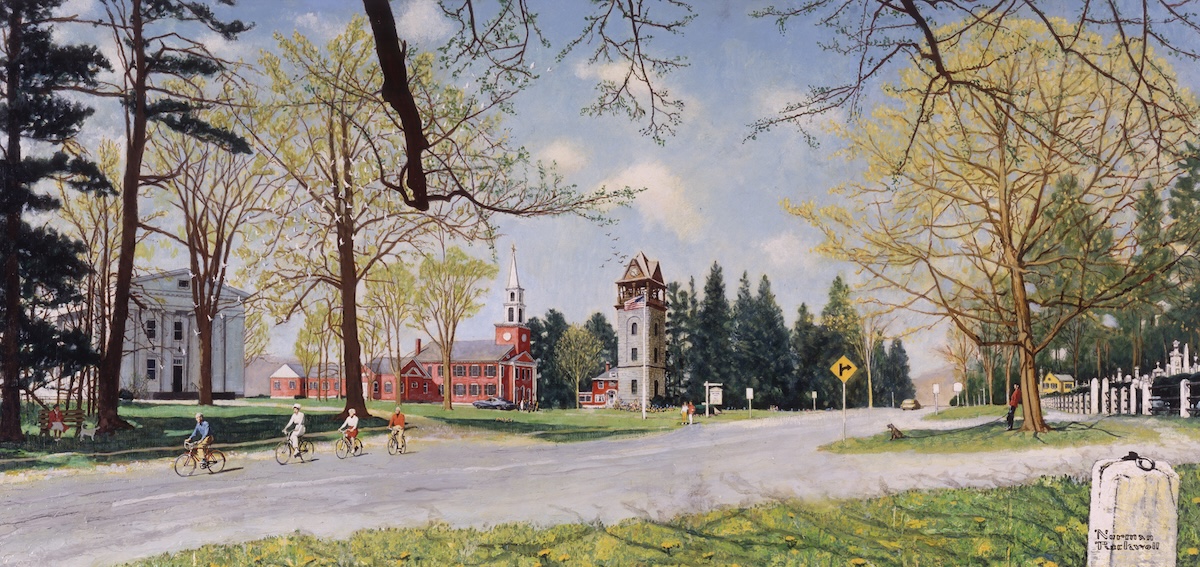
Springtime in Stockbridge features Rockwell on his daily bicycle ride through town on a street that is alive with greenery. He and his companions, including his wife Molly pedal along West Main Street. Leaning against a tree by the town cemetery, Rockwell’s studio assistant, Louie Lamone, is seen on the right. The painting was published in Look Magazine in 1971 to illustrate an essay celebrating the Norman Rockwell’s 78th spring, written by the magazine’s art director who had worked with the artist for 7 years.
Weather permitting, Rockwell bicycled nearly every day. “You know,” Rockwell used to say, “a painter’s legs go first, like a ball player’s. This is my way to stay active.” Rockwell’s typical bike route would have taken him from his house adjacent to the Red Lion Inn westward along Main Street, Church Street, and Route 102 to Averic Lake and then backwards along the same route, for a distance of approximately 8 miles. Although this route is largely flat, there are a couple of long hills and dirt roads that would give even a more experienced rider a challenge. And Rockwell rode this route daily well into his 70’s!
The painting includes several notable Stockbridge landmarks. Originally built in 1824, the First Congregational Church is the Federal-style brick structure. Erected in 1878 is the Dudley Field Memorial Tower or Children’s Chime Tower constructed of stone topped with a wooden belfry. Gifted to the town in memory of his grandchildren, David Dudley Field II requested that the bells ring every evening at 5:30 between “apple blossom time and the first frost on the pumpkin.” Also visible is Procter Hall, erected in 1839 formerly the town hall. In 1903, the white Greek Revival building was expanded with a Neo-Classical style addition.
Thanks to the commitment of Stockbridge town officials, residents, and the local historical society to preserve the original character of the town, this view of Stockbridge from more than 50 ago remains almost identical today