
English
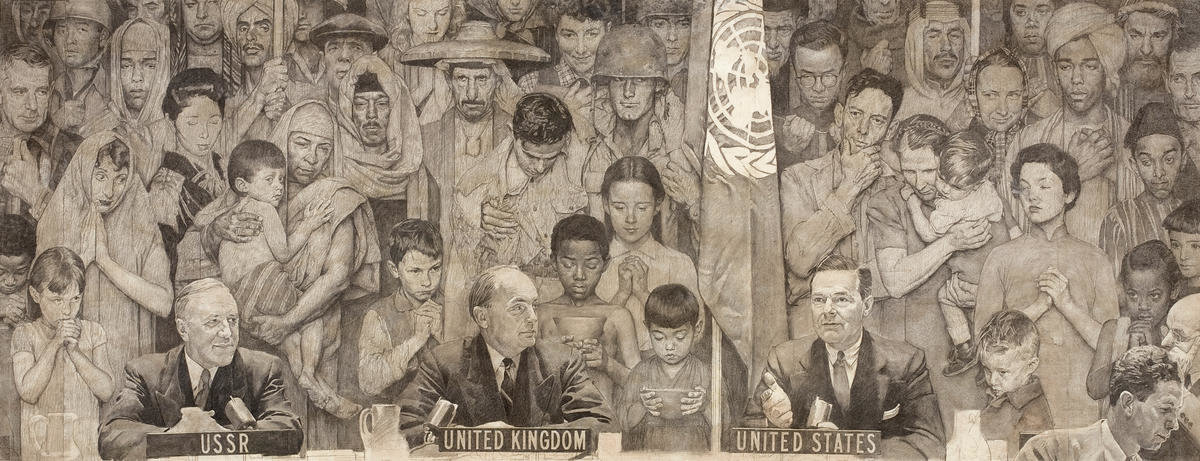
United Nations
1953
charcoal, pencil/paper
By Norman Rockwell
Norman Rockwell Museum Collection
Narrated by:
Mark Shulman
History Faculty – Sarah Lawrence College
Franklin Roosevelt’s package of Four Freedoms was an effort to articulate a vision for a post-war liberal order for security, for peace and prosperity as elements necessary for security just as much as the civil and political rights of freedom of religion and the freedom of expression.
The Four Freedoms were embraced in the Atlantic Charter that Roosevelt worked out with Churchill, and then they went into the DNA of the charter that the United Nations adopted in the summer of 1945. By the summer of 1945, of course, President Roosevelt had passed away. The United States had a new president, one, perhaps, less worldly and in some ways more practical. A savvy politician, President Truman appointed Eleanor Roosevelt, the widow of Franklin, to serve as the chief of the committee that would draft a United Nations Universal Declaration of Human Rights.
Eleanor, Mrs. Roosevelt, working with a committee of distinguished scholars, diplomats, theorists, and statesmen from around the world, drafted this wonderful document, the Universal Declaration of Human Rights, and the United Nations adopted it on December 10th, 1948. The Universal Declaration of Human Rights is the Four Freedoms writ large. The Preamble explicitly recognizes that the Four Freedoms have been adopted, have been recognized as the basis for a just postwar order. And then the Declaration itself proceeds to flesh out, to articulate, each of the elements that would really be necessary for a world in which the Four Freedoms are realized.
Spanish
United Nations (Naciones Unidas)
1953
carbón, lápiz/papel
Por Norman Rockwell
Colección del Museo Norman Rockwell
Narrado por:
Mark Shulman
Facultad de historia – Sarah Lawrence College
El paquete de las Cuatro Libertades de Franklin Roosevelt fue un esfuerzo para articular una visión de un orden liberal de posguerra para la seguridad, la paz y la prosperidad como elementos necesarios para la seguridad, así como los derechos civiles y políticos de la libertad de religión y la libertad de expresión.
Las Cuatro Libertades fueron aceptadas en la Carta del Atlántico que Roosevelt hizo con Churchill, y luego entraron en el ADN de la carta que las Naciones Unidas adoptaron en el verano de 1945. En el verano de 1945, por supuesto, el presidente Roosevelt había fallecido. Los Estados Unidos tenía un nuevo presidente, uno, quizás, menos mundano y, de alguna manera, más práctico. El inteligente presidente Truman nombró a Eleanor Roosevelt, la viuda de Franklin, como jefa del comité que redactaría la Declaración Universal de los Derechos Humanos de las Naciones Unidas.
Eleanor, la Sra. Roosevelt, trabajando con un comité de distinguidos académicos, diplomáticos, teóricos y estadistas de todo el mundo, redactaron este documento maravilloso, la Declaración Universal de los Derechos Humanos, y las Naciones Unidas lo aprobaron el 10 de diciembre de 1948. La Declaración Universal de los Derechos Humanos es las Cuatro Libertades escritas a lo grande. El Preámbulo reconoce explícitamente que las Cuatro Libertades han sido adoptadas, han sido reconocidas como la base para una orden justa de posguerra. Y luego, la propia Declaración procede a desarrollar, articular, cada uno de los elementos que serían realmente necesarios para un mundo en el que se realizan las Cuatro Libertades.
French
Les Nations Unies
1953
Fusain, crayon sur papier de Norman Rockwell
Collection du Musée Norman Rockwell
Narrateur :
Mark Shulman
Faculté d’Histoire – Université Sarah Lawrence
À travers son programme des Quatre Libertés, Franklin Roosevelt s’efforce d’apporter une vision d’un ordre libéral d’après-guerre, avec comme éléments fondateurs la sécurité, la paix et la prospérité, ainsi que les droits civiques et politiques de la liberté de religion et la liberté d’expression.
Les Quatre Libertés sont intégrées dans la Charte de l’Atlantique élaborée par Roosevelt et Churchill. Elles sont ensuite inscrites dans les principes fondateurs de la charte adoptée par les Nations Unies à l’été 1945, soit après le décès du Président Roosevelt. Les États-Unis ont un nouveau président, peut-être moins expérimenté, mais d’une certaine manière plus pragmatique. En homme politique avisé, le Président Truman nomme Eleanor Roosevelt, la veuve de son prédécesseur, à la tête du comité chargé de la rédaction d’un projet de Déclaration universelle des Droits de l’Homme des Nations Unies.
Eleanor Roosevelt, entourée d’un comité d’éminents spécialistes, diplomates, théoriciens et hommes d’État du monde entier, propose ce magnifique texte de la Déclaration universelle des Droits de l’Homme, adoptée par les Nations Unies le 10 décembre 1948. La Déclaration universelle des Droits de l’Homme est une version enrichie des Quatre Libertés. Le préambule stipule explicitement que les Quatre Libertés sont adoptées et reconnues comme le fondement d’un ordre mondial juste, en cette période d’après-guerre. De même, la Déclaration s’attache à énoncer précisément et à développer chacune des valeurs fondatrices d’un monde reconnaissant les Quatre Libertés.
German
United Nations (Vereinte Nationen)
1953
Kohle, Bleistift/Papier
Von Norman Rockwell
Norman Rockwell Museumssammlung
Erzählt von:
Mark Shulman
Historische Fakultät – Sarah Lawrence College
Franklin Roosevelts „Four Freedoms“-Paket diente dem Zweck, die Vision einer liberalen Ordnung der Sicherheit, des Friedens und des Wohlstands für die Zeit nach dem Krieg zu formulieren – Elemente, die für die Sicherheit ebenso wichtig waren wie die bürgerlichen und politischen Rechte der Religions- und Ausdrucksfreiheit.
Die vier Freiheiten wurden in die Atlantik-Charta aufgenommen, die Roosevelt mit Churchill zusammen ausarbeitete, und gingen danach in die im Sommer 1945 unterzeichnete Gründungsurkunde der Vereinten Nationen ein. Bis zum Sommer 1945 allerdings war Präsident Roosevelt bereits verstorben. Die Vereinigten Staaten hatten einen neuen Präsidenten – einen, der vielleicht etwas weniger weltgewandt, dafür aber in mancherlei Hinsicht praxisnaher war. Präsident Truman, ein versierter Politiker, bestellte Eleanor Roosevelt, die Witwe von Franklin D. Roosevelt, zur Vorgesetzten jener Kommission, die einen Entwurf für die Allgemeine Erklärung der Menschenrechte der Vereinten Nationen .
Eleanor Roosevelt verfasste gemeinsam mit einer Kommission aus angesehenen Gelehrten, Diplomaten, Theoretikern und Staatsmännern aus aller Welt dieses wunderbare Dokument, die Allgemeine Erklärung der Menschenrechte, und die Vereinte Nationen verabschiedeten sie am 10. Dezember 1948. Die vier Freiheiten kommen in der Allgemeinen Erklärung der Menschenrechte klar zum Ausdruck. In der Präambel wird ausdrücklich darauf hingewiesen, dass die vier Freiheiten übernommen werden und als Grundlage für eine gerechte Nachkriegsordnung anerkannt werden. Auch die Erklärung selbst konkretisiert und definiert sämtliche Elemente, die in einer Welt, in der man die vier Freiheiten realisieren will, unverzichtbar sind.
Japanese
United Nations
1953
国連1953
charcoal, pencil/paper
木炭、鉛筆/紙
By Norman Rockwell
ノーマン・ロックウェル
Norman Rockwell Museum Collection
ノーマンロックウェルミュージアムコレクション
Narrated by: Mark Shulman
History Faculty – Sarah Lawrence College
マーク・シュルマンによるナレーション付き
歴史学部 – サラローレンスカレッジ
Franklin Roosevelt’s package of Four Freedoms was an effort to articulate a vision for a post-war liberal order for security, for peace and prosperity as elements necessary for security just as much as the civil and political rights of freedom of religion and the freedom of expression.
フランクリン ルーズベルトの4つの自由は、信教の自由と言論の自由の民主的および政治的権利と同じくらい安全保障に必要な要素として、平和と繁栄のための戦後の自由秩序のビジョンを明確にするための努力でした。
The Four Freedoms were embraced in the Atlantic Charter that Roosevelt worked out with Churchill, and then they went into the DNA of the charter that the United Nations adopted in the summer of 1945.
ルーズベルトがチャーチルと協力した大西洋憲章には4つの自由が含まれていましたが、1945年の夏に国連が採択した憲章のDNAになりました。
By the summer of 1945, of course, President Roosevelt had passed away.
1945年の夏までにルーズベルト大統領は亡くなりました。
The United States had a new president, one, perhaps, less worldly and in some ways more practical.
米国にはおそらく世才のあまりない、実務に適した新しい大統領がいました。
A savvy politician, President Truman appointed Eleanor Roosevelt, the widow of Franklin, to serve as the chief of the committee that would draft a United Nations Universal Declaration of Human Rights.
賢明な政治家であるトルーマン大統領は、フランクリンの未亡人エレノア ルーズベルトを、国連世界人権宣言を草案する委員長に任命しました。
Eleanor, Mrs. Roosevelt, working with a committee of distinguished scholars, diplomats, theorists, and statesmen from around the world, drafted this wonderful document, the Universal Declaration of Human Rights, and the United Nations adopted it on December 10th, 1948.
1948年12月10日に国連は、エレノアルーズベルトと世界の著名な学者、外交官、理論家、政治家からなる委員会と協力して草案した世界人権宣言を採択しました。
The Universal Declaration of Human Rights is the Four Freedoms writ large.
世界人権宣言は4つの自由が大きく掲げられています。
The Preamble explicitly recognizes that the Four Freedoms have been adopted, have been recognized as the basis for a just postwar order.
前文は、4つの自由が採用されたことを明確にし、戦後の秩序の基礎として認識されています。
And then the Declaration itself proceeds to flesh out, to articulate, each of the elements that would really be necessary for a world in which the Four Freedoms are realized.
そして4つの自由が実現される世界に本当に必要な要素のそれぞれを具体化し明瞭にすることを進める宣言です。
Chinese
联合国
1953年
碳、铅笔/纸
创作者/诺曼·洛克威尔
诺曼·洛克威尔博物馆收藏
讲述人:
Mark Spelman
萨拉劳伦斯学院历史系
罗斯福的“四大自由系列”旨在阐明战后自由主义安全秩序的愿景,让和平与繁荣与信仰自由和言论自由等公民和政治权利都成为安全所需的要素。
“四大自由”被纳入罗斯福与丘吉尔签订的大西洋公约,并融入联合国1945年夏天颁布的宪章精神。当然,1945年夏天,罗斯福总统已经逝世。美国有了新总统——一位话少、更注重实干的总统。杜鲁门总统是一位非常聪明的政治家,他任命罗斯福总统的遗孀埃莉诺·罗斯福担任委员会主席,负责起草《联合国世界人权宣言》。
罗斯福夫人埃莉诺在委员会与世界各地的杰出学者、外交官、理论学者和政治家一起工作,起草了这份绝妙的文件——《世界人权宣言》,联合国于1948年12月10日通过了这份文件。《世界人权宣言》明显就是“四大自由”。序言明确承认采用“四大自由”理论,并将其作为战后秩序重建的基础。而《宣言》本身则不断充实,并清楚地阐明实现“四大自由”的世界真正需要的每一种要素。
Arabic
الأمم المتحدة
1953
فحم ، قلم رصاص / ورق
لـ نورمان روكويل
مجموعة متحف نورمان روكويل
الراوي:
مارك شولمان
كلية التاريخ – معهد سارا لورنس
كانت مجموعة الحريات الأربعة التي أعلنها فرانكلين روزفلت بمثابة محاولة لتوضيح رؤيةٍ لنظام أمني ليبيرالي لما بعد الحرب، حتى يكون السلم والازدهار عنصرين أساسيين للأمن بنفس قدر الحقوق المدنية والسياسية في حرية الدين والتعبير.
تمّ اعتماد الحريات الأربعة في الميثاق الأطلسي الذي وضعه كلّ من روزفلت وتشرشل، وبعدها فصّلوا الصيغة الأساسية للميثاق الذي تبنته الأمم المتحدة في صيف 1945. توفي الرئيس روزفلت كما هو معروف بحلول صيف سنة 1945. ترأّس الولايات المتحدة الأمريكية بعدها رئيس جديد، لعلّه أقلّ تجربة لكنه كان عمليّا أكثر في نواح كثيرة. عيّن الرئيس ترومان، السياسي المحنّك، إليانور روزفلت، أرملة فرانكلين لكي تشغل منصب رئيسة اللجنة التي من شأنها صياغة إعلان الأمم المتحدة العالمي لحقوق الإنسان.
صاغت السيّدة إليانور روزفلت، التي اشتغلت مع لجنة مكوّنة من أبرز العلماء والدبلوماسيين والمنظرين ورجال الدولة من جميع أرجاء العالم، هذه الوثيقة الرائعة، الإعلان العالمي لحقوق الإنسان، ولقد تبنته الأمم المتحدة في العاشر من كانون الأول ديسمبر من سنة 1948. الإعلان العالمي لحقوق الإنسان هو الصورة الأوضح للحريات الأربعة. تعترف الديباجة صراحة بتبنّي الحريات الأربعة واعتبارها أساسا لنظام عادل لما بعد الحرب. ويواصل الإعلان بعدها بلورة وتوضيح كلّ عنصر من العناصر التي ستكون بالغة الأهمية لبناء عالم تتحقّق فيه الحريات الأربعة.