
English
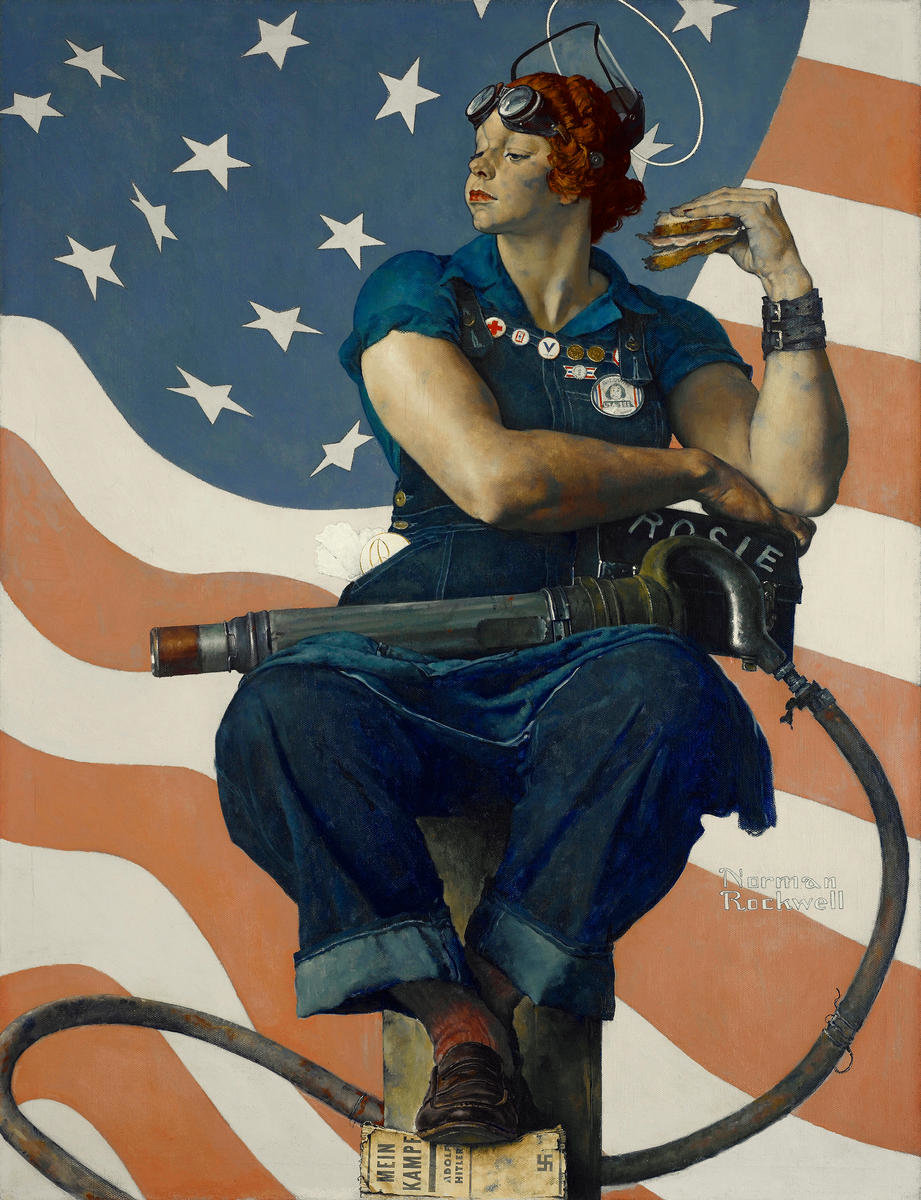
Rosie the Riveter,
Cover illustration for The Saturday Evening Post, May 29, 1943
Oil on canvas
By Norman Rockwell
Crystal Bridges Museum of American Art, Bentonville, Arkansas,
© 1943 SEPS – Curtis Publishing
Narrated By:
James J. Kimble, Ph.D.
Associate Professor of Communication – College of Communication and the Arts
Seton Hall University
This magnificent image is Norman Rockwell’s homage to the women of the home front. In it, he painted a muscular war worker—Rosie, according to the name on her lunch pail, and a riveter, according to the tool on her lap—at rest during a lunch break. Her pose is reminiscent of the prophet Isaiah on Michelangelo’s Sistine Chapel, and her upturned visor creates a halo—both features suggestive of a saintly interpretation. Rosie’s many buttons indicate how active she is on the home front, and the hose for her tool, featuring numerous repairs, suggests the importance of making do with the supplies one has at hand during wartime shortages. Most importantly, though, Rosie’s foot rests on a copy of Mein Kampf. Casually, even nonchalantly, she is showing utter contempt for Hitler’s Nazi forces, even as she demonstrates the power, enthusiasm and resolve of the many millions of American women—collectively, Rosie the Riveter—who signed up for factory work during the greatest war in history, ultimately showing the nation and the world their amazing willpower.
Spanish
Rosie the Riveter
(Rosie la remachadora)
Ilustración de portada para The Saturday Evening Post, 29 de mayo de 1943
Óleo sobre lienzo
Por Norman Rockwell
Museo de Arte Americano Crystal Bridges, Bentonville, Arkansas,
© 1943 SEPS – Curtis Publishing
Narrado por:
James J. Kimble, Ph.D.
Profesor Asociado de Comunicación – Facultad de Comunicación y Artes
Seton Hall University
Esta magnífica imagen es el homenaje de Norman Rockwell a las mujeres del frente interno durante la guerra. En él, pintó a una musculosa trabajadora para la guerra — de nombre Rosie, de acuerdo con el nombre en su lonchera, y una remachadora de acuerdo con la herramienta en su regazo — que está en reposo durante el almuerzo. Su pose es una reminiscencia del profeta Isaías en la Capilla Sixtina de Michelangelo, y su visera vuelta hacia arriba crea una aureola — ambas características que sugieren una interpretación santa. Los muchos botones en el cuello de la camisa de Rosie indican qué tan activa está en el frente interno. Y la manguera para su herramienta, que incluye numerosas reparaciones, sugiere la importancia de arreglárselas con los suministros que tenemos a mano durante la escasez en tiempos de guerra. Lo más importante, sin embargo, es que el pie de Rosie pisa una copia de Mein Kampf. De manera casual y despreocupante, muestra un profundo desprecio por las fuerzas nazis de Hitler, incluso cuando demuestra el poder, el entusiasmo y la resolución de las muchas millones de mujeres estadounidenses. En conjunto, Rosie la remachadora, que se inscribió para trabajar en una fábrica durante la guerra más grande la historia, muestra a la nación y el mundo su increíble fuerza de voluntad.
French
Rosie la riveuse,
Illustration de couverture pour le Saturday Evening Post, 29 mai 1943
Huile sur toile
Par Norman Rockwell
Musée de l’art américain de Crystal Bridges, Bentonville, Arkansas,
© 1943 SEPS – Curtis Publishing
Raconté par :
James J. Kimble, Ph.D.
Professeur associé de Communication – Collège de communication et des arts
Université Seton Hall
Cette magnifique image est l’hommage de Norman Rockwell aux femmes du front intérieur. Dans cette image, il a peint un travailleur de la guerre musclé, Rosie selon le nom sur sa gamelle, et une riveuse selon l’outil sur ses genoux, qui se repose durant la pause de déjeuner. Sa pose rappelle le prophète Isaiah sur la chapelle Sixtine de Michel-Ange, et son viseur tourné vers le ciel crée un effet de halo, les deux éléments suggèrent une interprétation sainte. Les nombreux boutons de Rosie indiquent à quel point elle est active sur le front intérieur, et le tuyau pour son outil, présentant plusieurs réparations, suggère l’importance du bricolage avec les équipements que quelqu’un a à sa disposition durant les pénuries de la guerre. Le plus important est que le pied de Rosie se repose sur une copie de Mein Kampf. Elle montre tout simplement son mépris envers les forces Nazies de Hitler, tout en démontrant la puissance, l’enthousiasme et la résolution de millions de femmes américaines, collectivement, Rosie la riveuse, qui ont occupé un travail d’usine durant la plus grande guerre dans l’histoire, en montrant en fin de compte à la nation et au monde leur incroyable volonté.
German
Rosie the Riveter (Rosie die Nieterin)
Titelbild für The Saturday Evening Post, 29. Mai 1943
Öl auf Leinwand
Von Norman Rockwell
Crystal Bridges Museum of American Art, Bentonville, Arkansas,
© 1943 SEPS – Curtis Publishing
Erzählt von:
James J. Kimble, Ph.D.
Außerordentlicher Professor der Kommunikation – College of Communication and the Arts
Seton Hall University
Dieses wunderbare Bild ist Norman Rockwells Hommage an die Frauen an der Heimatfront. Er stellt darin eine muskulöse Kriegsarbeiterin dar — Rosie, nach dem Namen, der auf ihrer Brotdose steht, und eine Nieterin, nach dem Werkzeug in ihrem Schoss — die gerade Mittagspause macht. Ihre Pose erinnert an den Propheten Jesaja von Michelangelo in der Sixtinischen Kapelle und ihre nach oben gewandte Blende erzeugt einen Heiligenschein — beide Elemente deuten auf die Auslegung von etwas Heiligem. Die vielen Ansteckplaketten von Rosie deuten an, wie aktiv sie an der Heimatfront ist, und der Schlauch für ihr Werkzeug weist zahlreiche Reparaturen auf und zeigt, wie wichtig es ist, mit den Mitteln Vorlieb zu nehmen, die während des Krieges in Zeiten des Mangels gerade zur Hand sind. Am wichtigsten ist allerdings, dass Rosies Fuß auf einer Ausgabe von Mein Kampf ruht. Lässig, fast unbekümmert, zeigt sie äußerste Geringschätzung für Hitlers Nazi-Truppen, auch indem sie die Kraft, den Enthusiasmus und die Entschlossenheit vieler Millionen amerikanischer Frauen — kollektiv, Rosie the Riveter — demonstriert, die während des größten Kriegs in der Geschichte, sich zur Arbeit in der Fabrik anmeldeten und damit letztlich der Nation und der Welt ihre erstaunliche Willenskraft zeigten.
Japanese
Rosie the Riveter,
ロージーリベッター
Cover illustration for The Saturday Evening Post, May 29, 1943
1943年5月29日サタデイイブニングポストの表紙イラスト
Oil on canvas
オイルキャンバス
By Norman Rockwell
ノーマン・ロックウェル作
Crystal Bridges Museum of American Art, Bentonville, Arkansas,
クリスタルブリッジズアメリカンアート美術館、ベントンビル、アーカンソー州、
© 1943 SEPS – Curtis Publishing
©1943 SEPS -カーティス出版
Narrated By: James J. Kimble, Ph.D.
Associate Professor of Communication – College of Communication and the Arts
Seton Hall University
ジェームスJキンブル 博士によるナレーション付き
コミュニケーション准教授 – コミュニケーションアンドアートカレッジ
セトンホール大学
This magnificent image is Norman Rockwell’s homage to the women of the home front.
この壮大なイメージは、ノーマン・ロックウェルの家庭の女性に対する敬意です。
In it, he painted a muscular war worker—Rosie, according to the name on her lunch pail, and a riveter, according to the tool on her lap—at rest during a lunch break.
その中で、彼は昼休み中の休憩時に、―彼女のランチペールの名前とリベッター、また彼女の膝の上の道具からして―屈強な戦士であるロージーを描きました。
Her pose is reminiscent of the prophet Isaiah on Michelangelo’s Sistine Chapel, and her upturned visor creates a halo—both features suggestive of a saintly interpretation.
彼女の姿勢は、ミケランジェロのシスティーナ礼拝堂の預言者イザヤを思い起こさせ、彼女の上向きのバイザーは、聖人の解釈を示唆する両方の特徴-後光を生み出します。
Rosie’s many buttons indicate how active she is on the home front, and the hose for her tool, featuring numerous repairs, suggests the importance of making do with the supplies one has at hand during wartime shortages.
ロージーの多くのボタンは、彼女が家庭でどれほど活発に働いているかを示しており、また何度も修復したツール用のホースは、戦時中に消耗品を日ごろから手に入れておくことの重要性を示唆しています。
Most importantly, though, Rosie’s foot rests on a copy of Mein Kampf.
しかし、最も重要なのは、ロージーの足が「我が闘争」のコピーの上に載っている点です。
Casually, even nonchalantly, she is showing utter contempt for Hitler’s Nazi forces, even as she demonstrates the power, enthusiasm and resolve of the many millions of American women—collectively, Rosie the Riveter—who signed up for factory work during the greatest war in history, ultimately showing the nation and the world their amazing willpower.
何気なく、まったく無意識であっても、彼女はヒットラーのナチス勢力に対する完全な軽蔑を示しており、何百万人ものアメリカ人女性の集団的な力、熱意、解決策を示しています。歴史における最大の戦争の間に工場作業にサインしたロージーリベッターは、最終的には国家と世界に彼らの驚くべき意志を示しています。
Chinese
“铆工露斯”
《星期六晚报》封面插图,1943年5月29日
布面油画
创作者/诺曼·洛克威尔
阿肯色州本顿维水晶桥美国艺术博物馆
© 1943 SEPS – Curtis Publishing
讲述人:
James J. Kimble 博士
传媒学副教授 – 传媒与艺术学院
西东大学
这幅壮丽的画作表达了诺曼·洛克威尔对留守后方的女性的致敬。他在画中描绘了一位在午休时间休息的强壮战时工人——露斯,根据她标有名字的午餐桶、铆钉和膝盖上的工具可得出这些信息。她的姿势让人不禁想起米开朗琪罗《西斯廷教堂》里的先知以赛亚,她头顶翘起的遮光板营造出神圣光环——这两点都是她圣洁的象征。露斯的那么多纽扣表明了她在国内大后方有多么大的贡献,她的工具上经过多次修补的软管暗示战时物资短缺时手头物品的重要性。最重要的是,露斯的脚踩在一本《我的奋斗》书上。顺便一提,她甚至毫不掩饰对希特勒纳粹势力的彻底蔑视,更展现了上百万美国女性(总称为“铆工露斯”)的强大、热情和决心,在史上最大战役爆发时自愿走进工厂工作,最终向全国和全世界人民展示了她们惊人的意志力。
Arabic
روزي المبرشمة
صورة غلاف لمجلة ساترداي ايفيننج بوست، 29 مايو 1943
لوحة زيتية
بواسطة نورمان روكويل
متحف كريستال بريدج للفن الأمريكي، بنتونفيل، أركنساس
© 1943 SEPS – إصدار دار كورتيس للنشر
رواه:
جيمس ج. كيمبل الحاص على الدكتوراه.
أستاذ مساعد في الاتصالات – كلية الاتصالات والفنون
جامعة سيتون هول
هذه اللوحة الرائعة هي تكريم من نورمان روكويل لنساء الجبهة الداخلية. في هذه اللوحة، رسم عاملة حرب صاحبة عضلات خلال وقت استراحة الغداء – أسماها روزي وذلك الاسم هو الاسم المذكور على سطل الغداء الخاص بها، ومبرشمة وذلك الاسم هو اسم الآلة التي كانت تحملها. تشبه وضعية الصورة وضعية النبي أشعيا على كنيسة سيستين الخاصة بمايكل أنجلو، ويخلق حاجبها المقلوب هالة – وكلاهما يوحي بشكل قديس. تشير أزرار روزي العديدة إلى مدى نشاطها على الجبهة الداخلية ويشير خرطوم الأداة التي تحملها والتي يظهر أنها خضعت للعديد من الإصلاحات إلى أهمية التمسك بالإمدادات التي نمتلكها خلال فترات الأزمات في وقت الحرب. والأهم من ذلك، هو أن قدم روزي تقف على نسخة من كتاب كفاحي. وبشكل عرضي وحتى دون مبالاة، فإنها تُظهر ازدراءً تامًا لقوى هتلر النازية، حتى إنها تُظهر قوة وحماس وعزيمة ملايين الأمريكيات – بشكل جماعي، روزي المبرشمة- اللواتي قبلن بالعمل في المصانع خلال أعظم حرب في التاريخ وأظهرن للأمة والعالم إرادتهم مذهلة بشكل رائع.