
English
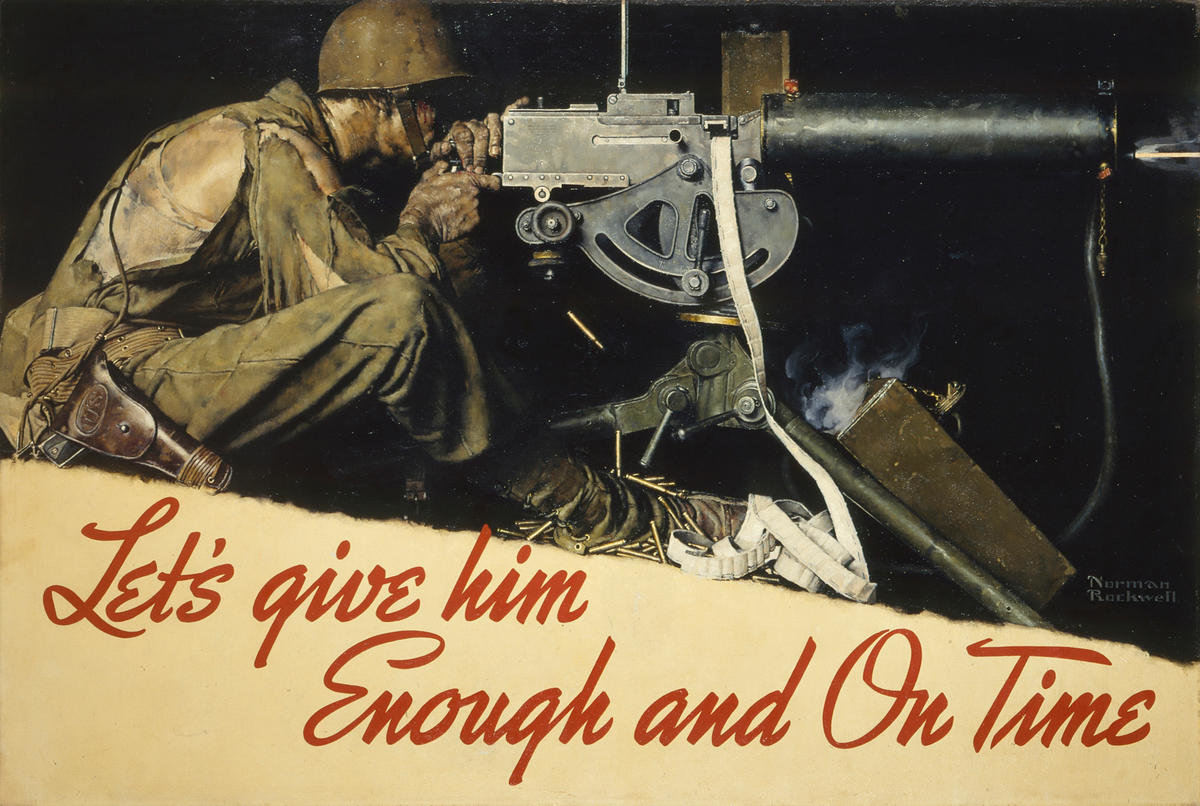
Let’s Give Him Enough and On Time,
S. Army Poster, 1942
By Norman Rockwell
Norman Rockwell Museum Collection
Narrated By:
James J. Kimble, Ph.D.
Associate Professor of Communication – College of Communication and the Arts
Seton Hall University
After the attack at Pearl Harbor, with the nation now at war, the artist Norman Rockwell reached out to the government to offer his illustration skills to the war effort. The US Army Ordnance Corps asked him to contribute to its so-called “Keep ‘Em Shooting” campaign, an effort to keep civilians motivated on the home front. Rockwell decided to depict a machine gun operator in a battle scene. Army officials were so eager for the Rockwell poster that when the artist asked for a machine gun to serve as a model, they sent him a fully-functioning weapon, live ammunition, a Jeep, and an enlisted soldier. The poster—with the caption “Let’s Give Him Enough and On Time” —was distributed nationally, and also appeared on numerous highway billboards in 1942. However, it was the only time in his career that Rockwell ever depicted an active combatant in a war front setting. His character Private Willie Gillis—by this time already famous—was much more characteristic of his light-hearted touch, even in war time.
Spanish
Let’s Give Him Enough and On Time
(Démosle suficiente y a tiempo)
Afiche del ejército de los Estados Unidos, 1942
Por Norman Rockwell
Colección del Museo Norman Rockwell
Narrado por:
James J. Kimble, Ph.D.
Profesor Asociado de Comunicación – Facultad de Comunicación y Artes
Seton Hall University
Después del ataque en Pearl Harbor, con la nación ahora en guerra, el artista Norman Rockwell se acercó al gobierno para ofrecer sus habilidades de ilustración para el esfuerzo de guerra. El Cuerpo de Artillería del Ejército de los EE. UU. Le pidió que contribuyera a su campaña llamada “Keep ‘Em Shooting” (Manténgalos Disparando) un esfuerzo por mantener a los civiles motivados en el frente interno. Rockwell decidió representar a un operador de ametralladora en una escena de batalla. Los oficiales del ejército estaban tan ansiosos por el afiche de Rockwell que cuando el artista pidió una ametralladora para que sirviera de modelo, le enviaron un arma completamente funcional, munición real, un Jeep y un soldado alistado. El afiche, con el letrero “Let’s Give Him Enough and On Time, (“Démosle suficiente y a tiempo”), se distribuyó a nivel nacional y también apareció en numerosas vallas publicitarias de autopistas en 1942. Sin embargo, fue la única vez en su carrera que Rockwell alguna vez representó a un combatiente activo en una scena de guerra. Su personaje, el soldado Willie Gillis, ya famoso por entonces, era mucho más característico de su toque alegre, incluso en tiempos de guerra.
French
Donnons-lui assez et à temps,
Affiche de l’armée des États-Unis, 1942
Par Norman Rockwell
Collection du musée Norman Rockwell
Raconté par :
James J. Kimble, Ph.D.
Professeur associé de Communication – Collège de communication et des arts
Université Seton Hall
Après l’attaque sur Pearl Harbor, avec la nation maintenant en guerre, l’artiste Norman Rockwell a contacté le gouvernement pour offrir ses compétences en illustration au service de la guerre. Le service de matériel de l’armée des États-Unis vous a demandé de contribuer à sa campagne appelée « Continuez à tirer », un effort pour maintenir les civils motivés au front intérieur. Rockwell a décidé de dessiner un opérateur de mitrailleuse dans une scène de bataille. Les officiers de l’armée étaient tellement impatients de voir l’affiche de Rockwell que lorsque l’artiste a demandé une mitrailleuse pour l’utiliser comme modèle, ils lui ont envoyé une arme qui fonctionne, des vraies balles, une jeep et un soldat. L’affiche avec le sous-titre « Donnons-lui assez et à temps » a été distribuée sur le territoire national et est apparue sur de nombreux tableaux d’affichage de l’autoroute en 1942. Cependant, c’était la seule fois dans la carrière de Rockwell qu’il a dessiné un combattant actif dans un environnement de guerre. Son personnage, le soldat Willie Gillis, à cette époque déjà célèbre, était plus connu par sa gaieté, même en temps de guerre.
German
Gib ihm ausreichend und rechtzeitig,
Plakat der U. S. Army, 1942
Von Norman Rockwell
Norman Rockwell Museum Collection
Erzählt von:
James J. Kimble, Ph.D.
Außerordentlicher Professor für Kommunikation – College of Communication and the Arts
Seton Hall University
Nach dem Angriff auf Pearl Harbor und dem Eintritt der Nation in den Krieg, wandte sich der Künstler Norman Rockwell an die Regierung, um bei den Kriegsanstrengungen seine zeichnerischen Fähigkeiten anzubieten. Das US Army Ordnance Corps bat ihn, einen Beitrag zur sogenannten „Keep ‘Em Shooting (Lass ihn weiter schießen)“ zu leisten, eine Bemühung, die Bürger an der Heimatfront motiviert zu halten. Rockwell entschied sich, einen Mann am Maschinengewehr in einer Kampfszene abzubilden. Beamte der Armee waren auf das Plakat von Rockwell so erpicht, dass, als der Künstler um ein Maschinengewehr bat, das ihm als Modell dienen sollte, sie ihm eine voll funktionsfähige Waffe, scharfe Munition, einen Jeep und einen rekrutierten Soldaten schickten. Das Plakat mit der Überschrift “Let’s Give Him Enough and On Time (Gib ihm ausreichend und rechtzeitig)” —wurde landesweit verteilt und erschien auch im Jahre 1942 auf zahlreichen Reklametafeln an Highways. Es war allerdings das einzige Mal während seiner Laufbahn, dass in Rockwell einen aktiven Kämpfer an einem Kriegsschauplatz abbildete. Seine Figur Private Willie Gillis, die zu der Zeit bereits berühmt war, war auch in Kriegszeiten für seinen unbeschwerten Ansatz sehr viel charakteristischer.
Japanese
Let’s Give Him Enough and On Time,
彼に十分な時間を与えよう。
- S. Army Poster, 1942
1942年の米軍のポスター
By Norman Rockwell
ノーマン・ロックウェル作
Norman Rockwell Museum Collection
ノーマンロックウェルミュージアムコレクション
Narrated By: James J. Kimble, Ph.D.
Associate Professor of Communication – College of Communication and the Arts
Seton Hall University
ジェームスJキンブル 博士によるナレーション付き
コミュニケーション准教授 – コミュニケーションアンドアートカレッジ
セトンホール大学
After the attack at Pearl Harbor, with the nation now at war, the artist Norman Rockwell reached out to the government to offer his illustration skills to the war effort.
真珠湾攻撃の後、国家の戦争中、ノーマン・ロックウェルは、戦争の努力としてイラストレーション技能を提供するために政府に連絡を取りました。
The US Army Ordnance Corps asked him to contribute to its so-called “Keep ‘Em Shooting” campaign, an effort to keep civilians motivated on the home front.
米軍軍需品部は、民間人を家庭から行動させるための努力として、いわゆる「エムシューティング」キャンペーンに貢献するよう依頼しました。
Rockwell decided to depict a machine gun operator in a battle scene.
ロックウェルは、戦闘シーン中のマシンガンオペレーターを描くことに決めました。
Army officials were so eager for the Rockwell poster that when the artist asked for a machine gun to serve as a model, they sent him a fully-functioning weapon, live ammunition, a Jeep, and an enlisted soldier.
陸軍の職員は、ロックウェルのポスターを見たいと思っていたので、マシンガンをモデルにするため1セット提供するよう依頼されたとき、実際に使用可能な武器、弾薬、ジープ、兵士を彼に送りました
The poster—with the caption “Let’s Give Him Enough and On Time” —was distributed nationally, and also appeared on numerous highway billboards in 1942.
ポスターは、「彼に十分な時間を与えよう」という表題で、全国的に配布され、1942年には多数の高速道路の掲示板にも掲載されました。
However, it was the only time in his career that Rockwell ever depicted an active combatant in a war front setting.
しかし、最前線で積極的に働く戦闘員をロックウェルが描いたのは、彼のキャリアの中でこれが唯一でした。
His character Private Willie Gillis—by this time already famous—was much more characteristic of his light-hearted touch, even in war time.
彼のキャラクター、プライベート・ウィリー・ギリス-このときすでに有名でした-は、戦時中でさえ、彼の軽いタッチの描き方のおかげではるかに特徴的でした。
Chinese
及时为他充分提供所需
美国军队海报,1942年
创作者/诺曼·洛克威尔
诺曼·洛克威尔博物馆收藏
讲述人:
James J. Kimble 博士
传媒学副教授 – 传媒与艺术学院
西东大学
珍珠港袭击事件发生后,整个国家处于战争状态,艺术家诺曼·洛克威尔则自主联系政府,主动提出用自己的插画技能支持战争。美国陆军军械部要求他为所谓的“Keep’Em Shooting”(继续射击)运动做贡献,努力保持美国民众的积极性。洛克威尔决定描绘一个战场上的机枪操作兵。军队军官非常期待洛克威尔的海报,因此当他要求获得一杆机关枪作为模型时,他们为他送去了一套功能齐全的真枪、实弹、一辆吉普车和一名士兵。1942年,冠以“Let’s Give Him Enough and On Time”(及时为他充分提供所需)标题的海报在全国流传开,还出现在众多高速公路广告牌上。不过,这是洛克威尔在其职业生涯中唯一一次以积极的方式描绘战场前线的战士。他的主人公Willie Gillis列兵——现在已十分有名——更能体现他轻松风趣的特点,战时亦不例外。
Arabic
دعونا نعطيه ما يكفي وفى الوقت المناسب
ملصق لجيش الولايات المتحدة الأمريكية، 1942
بواسطة نورمان روكويل
مجموعة متحف نورمان روكويل
رواه:
جيمس ج. كيمبل الحاص على الدكتوراه.
أستاذ مساعد في الاتصالات – كلية الاتصالات والفنون
جامعة سيتون هول
بعد الهجوم على ميناء بيرل، ووجود الأمة في حالة حرب، قام الفنان نورمان روكويل بالتواصل مع الحكومة لتقديم مهاراته الرسومية كمجهود حربي. طلبت منه فرقة السلاح والذخيرة في الجيش الأمريكي المساهمة في حملتها المسماة “استمروا في إطلاق النار” وهي محاولة للحفاظ على تحفيز المدنيين على الجبهة الداخلية. قرر روكويل تصوير عامل رشاش آلي في ساحة المعركة. كان المسؤولون في الجيش متلهفين لرؤية ملصق روكويل لدرجة أنه عندما طلب الفنان سلاحًا آليًا ليكون نموذجًا يعتمد عليه في الرسم، أرسلوا إليه سلاحًا يعمل بشكل كامل وبه ذخيرة حية وسيارة جيب وجندي مجند في الجيش. تم توزيع الملصق – بعنوان “دعونا نعطيه ما يكفي وفي الوقت المناسب” – على الصعيد الوطني، كما ظهر على العديد من لوحات الإعلانات على الطرق السريعة في عام 1942. ومع ذلك، كانت هذه هي المرة الوحيدة في مسيرته التي صور فيها روكويل أحد المقاتلين الفعليين في جبهة القتال. كانت شخصيته الخيالية الجندي ويلي جليس – التي اشتهر بها في ذلك الوقت – أكثر ما يميز ويظهر لمسته الفنية الخفيفة حتى في وقت الحرب.