
English
Norman Rockwell
Boy in Dining Car, c. 1946
Cover illustration for The Saturday Evening Post (December 7, 1946)
Oil on canvas
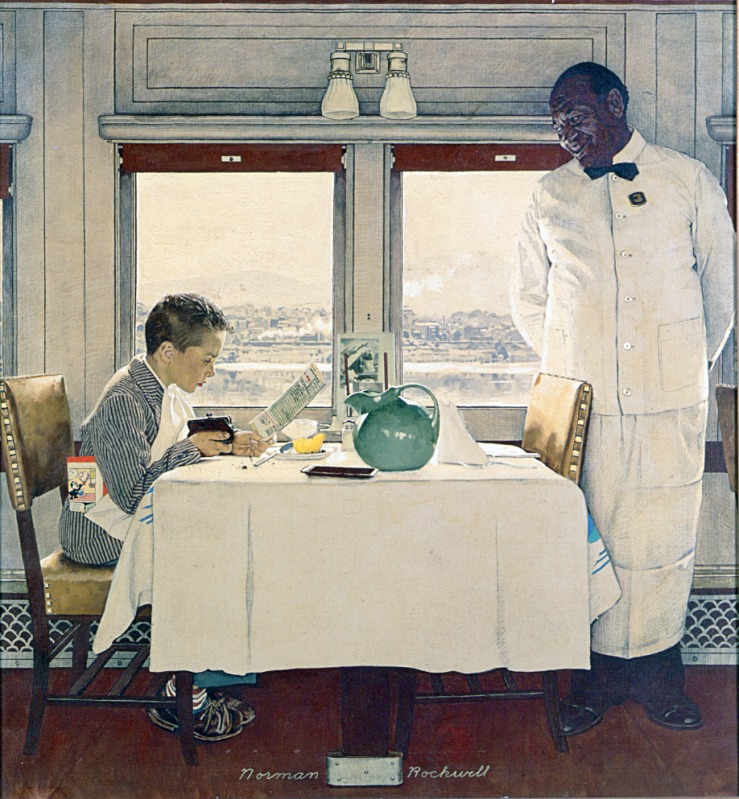
PETER ROCKWELL: This boy is traveling by train on his own, and has just eaten a meal in the dining car. We now see him trying to figure out the tip–perhaps for the very first time–as the dining car waiter looks on.
I’m very familiar with “Boy in a Dining Car” since that’s me posing as the character of the boy. I wasn’t my father’s first choice. He tried out four other boys, including one of my brothers, before he decided to use me.
The New York Central Railroad pulled an actual dining car off a train and had it waiting in New York for my father to paint. It was off a brand new “20th Century Limited” train, and when my father saw it he decided it looked too new, and got an older train car instead.
The day I posed in the dining car was the hottest day of the year. I complained so much that my father promised to take my to F.A.O. Schwartz and buy me anything I wanted if I would just be quiet. I was quiet and he came through and bought me some army trucks. My father did pay his children when we posed for him. But other people got five dollars and my brothers and I only got one dollar. I really resented that!
Part 2
PETER ROCKWELL: The man modeling as the waiter was a real dining car waiter. Again, my father posed three other waiters before he was satisfied he’d found just the right model. The Saturday Evening Post had an unwritten rule how people were to be depicted on the magazine’s cover. Until the Civil Rights Era, African Americans were generally pictured in service industry professions. In the 1960’s, however, my father’s illustrations for Look Magazine provided him the opportunity to portray the struggle for equal rights in America.
Family
Norman Rockwell
Boy in Dining Car, c. 1946
Cover illustration for The Saturday Evening Post (December 7, 1946)
Oil on canvas
PETER ROCKWELL: Hi, I’m the boy in this painting. I was about ten years old when I posed for this picture. I’m a little bit older now. My name’s Peter Rockwell, and Norman Rockwell was my father.
It might look like I’m sitting in a fancy restaurant, but this is actually the dining car of a train. This was way back in 1946 when people on trains traveled in style! The story here is I’ve just had my meal and now I need to pay the check. I’ve been doing some reading. See the comic book stuffed in my jacket pocket? Now I have to figure out how much to leave as a tip for the waiter–that’s him standing on the other side of the table. The waiter has probably guessed that I’ve never done this before. He thinks it’s a little funny, but he won’t laugh out loud.
I posed for this painting in a real train car. It was in August, and it was the hottest day of the year. I complained the whole time. Finally, my father said if I stopped complaining, he’d take me to the toy store and would buy me anything I wanted. That did the trick. I stopped complaining, and later I went home with some new army trucks.
Spanish
Norman Rockwell
Boy in Dining Car, c. 1946
Cover illustration for Saturday Evening Post (December 7, 1946)
Oil on canvas
Peter Rockwell: Este pequeño viaja solo en tren, y acaba de comer en el vagón-comedor. Lo vemos tratando de calcular la propina, tal vez por primera vez en su vida, mientras el camarero espera. Estoy muy familiarizado con este cuadro – Niño en vagón-comedor — ya que soy yo posando como el personaje del niño. Yo no fui la primera opción de mi padre. Intentó utilizar a otros cuatro niños, incluyendo a uno de mis hermanos, antes de decidir usarme a mí.
Los Ferrocarriles Centrales de Nueva York de hecho sacaron de circulación un vagón-comedor real, y lo pusieron a disposición de papá en Nueva York. Era un tren Siglo XX Limited, totalmente nuevo. Y cuando mi padre lo vió por vez primera, decidió que se veía demasiado nuevo y reluciente, por lo que utilizó un vagón más viejo.
El día que posé en el vagón-comedor fue el día más caliente del año. Me quejé tanto que papá prometió llevarme a la juguetería FAO Schwarz y comprarme lo que yo quisiera, tan solo si dejaba de moverme y de hablar. Lo hice, y él cumplió su promesa y me compró unos camiones militares de juguete.
Mi padre solía pagarles a sus hijos cuando posaban para él, pero mientras otras personas recibían $5, a mis hermanos y a mí tan solo nos daba $1; no me parecía justo. Si desea escuchar información adicional, oprima Play en este momento.
Spanish Family
Norman Rockwell
Boy in Dining Car, c. 1946
Cover illustration for Saturday Evening Post (December 7, 1946)
Oil on canvas
Peter Rockwell: [inglés] Hi! I’m the boy in this painting … Yo soy el niño de esta pintura. Tenía como 10 años cuando posé para ella. Ahora estoy un poquito más grande. Me llamo Peter Rockwell, y Norman Rockwell era mi papá.
Parecería que estoy sentado en un restaurante de lujo, pero en realidad estoy en el vagón-comedor de un tren. Sucedió en 1946, cuando la gente viajaba en tren con gran estilo. La idea representada aquí es que acabo de terminar de comer, y ahora debo pagar la cuenta.
Se nota que he estado leyendo. ¿Puedes ver el cómic que está guardado en el bolsillo de mi chaqueta?
Ahora debo calcular cuánto debo dejarle de propina al camarero, quien está parado al otro lado de la mesa. El camarero probablemente se dió cuenta de que nunca antes había hecho esto, por lo que le parece un poco cómico, pero no desea reírse en voz alta.
Posé para este cuadro en un vagón-comedor de verdad. Era el mes de agosto, y fue el día más caluroso del año. Me estuve quejando todo el tiempo, hasta que papá me dijo que si dejaba de quejarme me llevaría a una juguetería y me compraría lo que yo quisiera. Esa fue la solución. Me dejé de quejar, y más tarde llegué a casa con nuevos camiones militares de juguete.