
English
Freedom of Worship
Illustration for The Saturday Evening Post, February 27, 1943
Oil on canvas
By Norman Rockwell
Norman Rockwell Museum Collection
© 1943 SEPS – Curtis Publishing
Narrated By:
Stephanie Haboush Plunkett
Deputy Director / Chief Curator – Norman Rockwell Museum
Freedom of Worship posed a challenge for Rockwell, for he understood that religion was a deeply personal and sometimes delicate subject. He wanted to paint an image conveying unity despite differences, presenting a vision for a world without discrimination based upon is religious practice or belief.
His initial concept depicted an amicable scene in a country barbershop, in which a Jewish man is attended to by a barber, while a Catholic priest and an African American man wait their turn. But Rockwell found upon almost completing the image, that it presented a stereotypical view, so dissatisfied with this approach, he set it aside and started over again.
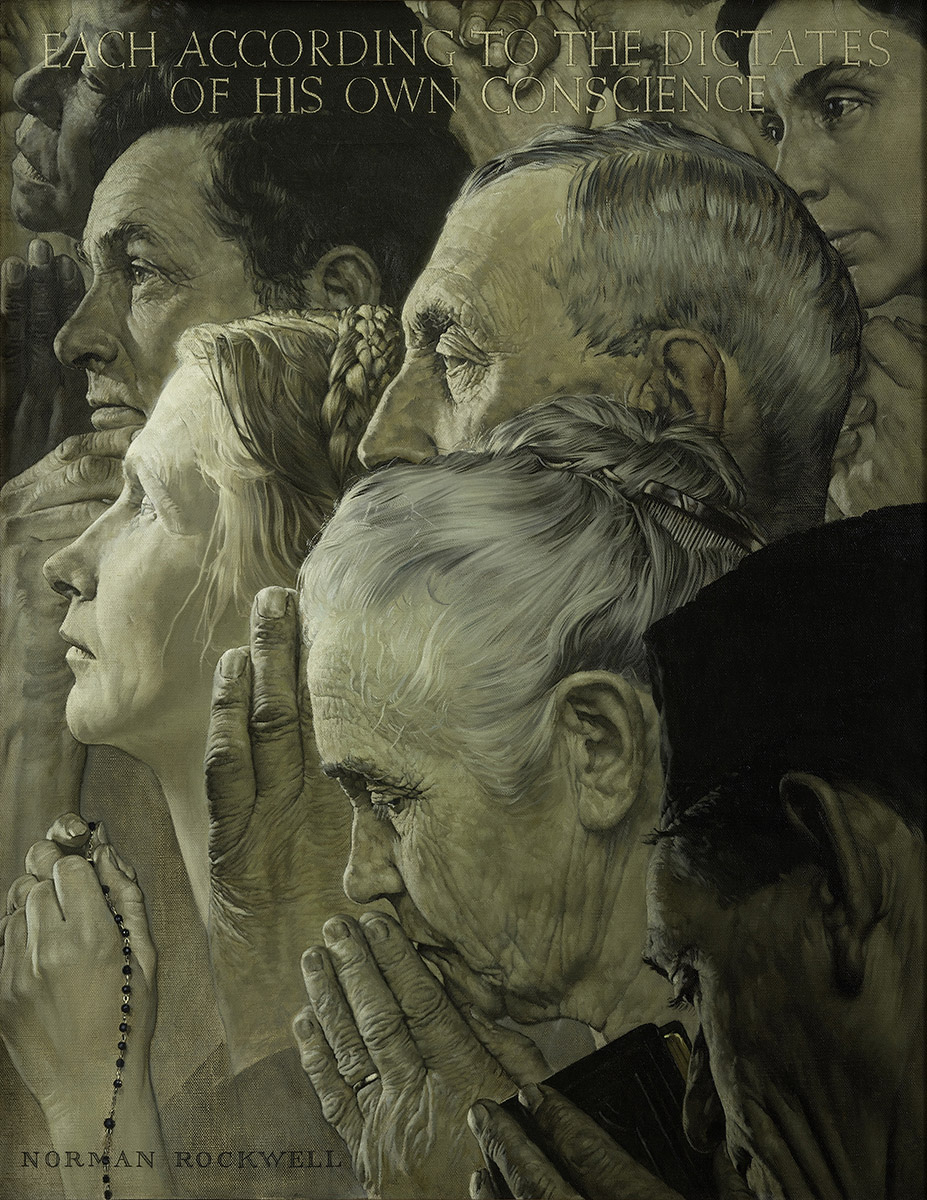
The final image that we see today focuses more on the concept of worship rather than the concept of religion and is composed of the profiles of eight heads in a shallow visual space. The various figures represent people of different faiths in a moment of prayer. The image was painted as in monochromatic hues to provide a sense of inclusion and unity.
Rockwell felt that in a composition, the positions and gestures of hands are second only to the expressive qualities of faces, as is exemplified in Freedom of Worship. The wording “Each according to the dictates of his own conscience.” was a phrase that reflected Rockwell’s own thoughts on religion. When asked where he had heard these words, Rockwell could not recall. In fact, the phrase exists in many state constitutions of the United State, and was also used by George Washington in a letter penned to the United Baptist Chamber of Virginia, in 1789.
Spanish
Freedom of Worship (Libertad de Culto)
Ilustración para The Saturday Evening Post, 27 de febrero de 1943
Oil on canvas (nombre en inglés)
Por Norman Rockwell
Colección de Museo de Norman Rockwell
© 1943 SEPS – Curtis Publishing
Narrado por:
Stephanie Haboush Plunkett
Directora Adjunto / Conservadora General – Museo Norman Rockwell
Freedom of Worship representaba un desafío para Rockwell, ya que entendía que la religión era un tema profundamente personal y, a veces, delicado. Quería pintar una imagen que transmitiera la unidad a pesar de las diferencias, presentando una visión de un mundo sin discriminación basada en la práctica o creencia religiosa.
Su concepto inicial representaba una escena amistosa en una barbería rural, en la que un judío es atendido por un barbero, mientras que un sacerdote católico y un afroamericano esperaban su turno. Pero Rockwell descubrió casi terminando la imagen, que esta presentaba una visión estereotípica, entonces insatisfecho con este enfoque, la dejó de lado y comenzó de nuevo.
La imagen final que vemos hoy se centra más en el concepto de culto que en el concepto de religión y está compuesta por los perfiles de ocho cabezas en un espacio visual poco profundo. Las diversas figuras representan personas de diferentes creencias en un momento de oración. La imagen fue pintada en tonos monocromáticos para proporcionar una sensación de inclusión y unidad.
Rockwell pensaba que, en una composición, las posiciones y los gestos de las manos son secundarios después de las cualidades expresivas de los rostros, como se ejemplifica en Freedom of Worship. La frase “Cada uno de acuerdo con los dictados de su propia conciencia” era una frase que reflejaba los propios pensamientos de Rockwell sobre la religión. Cuando se le preguntó dónde había escuchado estas palabras, Rockwell no pudo recordar. De hecho, la frase existe en muchas constituciones estatales de los Estados Unidos, y también fue utilizada por George Washington en una carta escrita a la United Baptist Chamber of Virginia, en 1789.
French
Freedom of Worship (Liberté de culte – NDT)
Illustration pour le Saturday Evening Post, Le 27 février 1943
Huile sur toile
Par Norman Rockwell
Collection du musée Norman Rockwell
© 1943 SEPS – Éditions Curtis
Raconté par :
Stephanie Haboush Plunkett
Directeur adjoint / conservateur en chef – Norman Rockwell Museum
Freedom of Worship a été un défi pour Rockwell car il a compris que la religion était un sujet profondément personnel et parfois délicat. Il voulait peindre une image véhiculant l’unité malgré les différences, présentant une vision pour un monde sans discrimination fondée sur la pratique ou la croyance religieuse.
Son concept initial dépeint une scène amicale chez un coiffeur de campagne, où un barbier s’occupe d’un juif, tandis qu’un prêtre catholique et un afro-américain attendent leur tour. Cependant, alors qu’il avait presque terminé la peinture, Rockwell a trouvé qu’elle présentait une vision stéréotypée, et fut tellement insatisfait de cette approche, qu’il l’a mise de côté et a recommencé.
L’oeuvre finale que nous voyons aujourd’hui se concentre plus sur le concept de culte que sur le concept de religion et est composée des profils de huit têtes dans un espace visuel réduit. Les différents visages représentent des personnes de différentes confessions dans un moment de prière. L’oeuvre a été peinte dans des teintes presque monochromatiques pour donner un sentiment d’inclusion et d’unité.
Rockwell a estimé que dans une composition, les positions et les gestes des mains sont seulement secondaires par rapport aux qualités expressives des visages, comme cela est illustré dans Freedom of Worship. Le libellé « Chacun selon ce que lui dicte sa propre conscience. » était une phrase qui reflétait l’opinion personnelle de Rockwell sur la religion. Lorsqu’on lui a demandé où il avait entendu ces mots, Rockwell n’a pas réussi à s’en souvenir. En fait, l’expression existe dans de nombreuses constitutions d’États des États-Unis et a également été utilisée par George Washington dans une lettre écrite à la United Baptist Chamber of Virginia, en 1789.
German
Freedom of Worship (Freiheit des Glaubens)
Illustration für The Saturday Evening Post, 27. Februar 1943
Öl auf Leinwand
Von Norman Rockwell
Norman Rockwell Museumssammlung
© 1943 SEPS – Curtis Publishing
Erzählt von:
Stephanie Haboush Plunkett
Stellvertretende Leiterin / Chefkuratorin – Norman Rockwell Museum
Freedom of Worship stellte für Rockwell eine Herausforderung dar, weil ihm bewusst war, dass Religion eine zutiefst private und manchmal auch heikle Angelegenheit ist. Er wollte ein Bild malen, das Eintracht trotz bestehender Unterschiede vermittelte und die Vision einer Welt präsentierte, auf der es keine Diskriminierung wegen religiöser Praktiken oder des religiösen Glaubens gibt.
Sein ursprüngliches Konzept zeigte eine friedliche Szene in einem ländlichen Frisörladen, in dem ein jüdischer Mann von einem Frisör bedient wird, während ein katholischer Priester und ein Afroamerikaner warten, bis sie an der Reihe sind. Kurz vor der Fertigstellung des Bildes gewann Rockwell jedoch den Eindruck, dass es eine stereotype Sichtweise präsentierte, und so nahm er, unzufrieden mit seinem Ansatz, davon Abstand und begann noch einmal von vorn.
Das endgültige Bild, das wir heute sehen, konzentriert sich stärker auf das Konzept des Glaubens als auf das Konzept der Religion und zeigt die Profilansichten von acht Köpfen in einem Bildraum mit geringer Tiefe. Die verschiedenen Personen stellen Menschen unterschiedlichen Glaubens beim Gebet dar. Das Bild wurde in monochromen Farbschattierungen gemalt, um ein Gefühl der Eingliederung und Einheit zu vermitteln.
Rockwell war der Auffassung, dass in einer Komposition die Körperhaltungen und Gesten im Vergleich zur Ausdrucksqualität der Gesichter nur zweitrangig sind, wie am Beispiel von Freedom of Worship deutlich wird. Die Formulierung „Each according to the dictates of his own conscience“ („Jeder nach den Geboten, die sein eigenes Gewissen ihm auferlegt“) gab Rockwells eigene Gedanken zum Thema Religion wieder. Als er gefragt wurde, wo er diese Worte gehört habe, konnte Rockwell sich nicht daran erinnern. Tatsächlich kommt dieser Satz in vielen Verfassungen US-amerikanischer Bundesstaaten vor und wurde auch von George Washington in einem Brief verwendet, den er 1789 an die United Baptist Chamber of Virginia (Kammer der vereinigten Baptisten von Virginia) schrieb.
Japanese
Freedom of Worship
信教の自由
Illustration for The Saturday Evening Post, February 27, 1943
1943年2月27日サタデイイブニングポストのイラスト
Oil on canvas
オイルキャンバス
By Norman Rockwell
ノーマン・ロックウェル作
Norman Rockwell Museum Collection
ノーマンロックウェルミュージアムコレクション
© 1943 SEPS – Curtis Publishing
©1943 SEPS -カーティス出版
Narrated By: Stephanie Haboush Plunkett
Deputy Director / Chief Curator – Norman Rockwell Museum
ステファニー・ハボース・プランケットによるナレーション付き
副所長/チーフキュレーター – ノーマンロックウェル博物館
Freedom of Worship posed a challenge for Rockwell, for he understood that religion was a deeply personal and sometimes delicate subject.
宗教は非常に個人的で時にはデリケートな主題であることを彼は理解していたため、信教の自由はロックウェルにとって挑戦でした。
He wanted to paint an image conveying unity despite differences, presenting a vision for a world without discrimination based upon is religious practice or belief.
彼は差異があるにもかかわらず統一性を伝えられるイメージを描くことを望んだため、宗教上の習慣や信念に基づき且つ差別のない世界のビジョンを提示したのです。
His initial concept depicted an amicable scene in a country barbershop, in which a Jewish man is attended to by a barber, while a Catholic priest and an African American man wait their turn.
彼の初期のコンセプトは、カトリックの司祭とアフリカ系アメリカ人の男が自分の順番を待つ間に、ユダヤ人の男が散髪してもらっている田舎の理髪店という親しみやすい場面を描きました。
But Rockwell found upon almost completing the image, that it presented a stereotypical view, so dissatisfied with this approach, he set it aside and started over again.
しかし、絵はほぼ完成していましたが、ステレオタイプのビューを提示していたので、ロックウェルはこのアプローチには不満があり、別の場所に置いて、やり直しました。
The final image that we see today focuses more on the concept of worship rather than the concept of religion and is composed of the profiles of eight heads in a shallow visual space.
現在の最終的な絵は、宗教の概念ではなく礼拝の概念に焦点を当てており、浅い視覚空間に8つの頭部のプロファイルで構成されています。
The various figures represent people of different faiths in a moment of prayer.
様々な数字は、祈りの時間の中における異なる信仰の人々を表しています。
The image was painted as in monochromatic hues to provide a sense of inclusion and unity.
画像は単色の色相で描かれ、多様性の受け入れと統一感を与えています。
Rockwell felt that in a composition, the positions and gestures of hands are second only to the expressive qualities of faces, as is exemplified in Freedom of Worship.
ロックウェルは、構図において、手の位置と身振りは、「信教の自由」の中に示されているように、顔の表情的な性質に次ぐものであると感じました。
The wording “Each according to the dictates of his own conscience.” was a phrase that reflected Rockwell’s own thoughts on religion.
「各自は自分の良心の指示に従うべし」という表現は、 ロックウェル自身の宗教思想を反映したフレーズでした。
When asked where he had heard these words, Rockwell could not recall.
どこでこれらの言葉を聞いたのか尋ねられたとき、ロックウェルは思い出すことができませんでした。
In fact, the phrase exists in many state constitutions of the United State, and was also used by George Washington in a letter penned to the United Baptist Chamber of Virginia, in 1789.
実際、このフレーズは、米国の多くの州の憲法に存在し、1789年にバージニア州の連合バプテスト協議会(United Baptist Chamber)に送られたジョージ・ワシントンの手紙でも使用されました。
Chinese
信仰自由
《星期六晚报》 插画,1943年2月27日
布面油画
创作者/诺曼·洛克威尔
诺曼·洛克威尔博物馆收藏
© 1943 SEPS – Curtis Publishing
讲述人:
Stephanie Haboush Plunkett
副总监 / 总策展人 – 诺曼·洛克威尔博物馆
《信仰自由》对洛克威尔来说是一个巨大挑战,因为他认为宗教是一件非常个人化、甚至十分微妙的事情。他希望最终呈现的作品能表现“求同存异”的含义,传达一个没有因宗教实践或宗教信仰而歧视的世界观。
他的最初想法是描绘一幅乡村理发店中的场景,理发师正在为犹太人理发,而一位天主教神父和一名非裔美国人正在排队等候。在几近完成的时候,洛克威尔发现它表现的观点十分老套刻板,而他对此并不满意;于是,他把它弃置一旁从头开始。
我们今天看到的最终作品更注重崇拜的概念而非宗教概念,这个近角画面中有八个人物侧面相,表现的是不同信仰的人祈祷时的样子。整幅画采用单色调的绘画方法,给人一种包容和团结感。
洛克威尔认为,在构图时,手的位置和姿势仅次于面部表情特征,正如《信仰自由》所体现的那样。“每个人都受自己内心良知的驱使”正是洛克威尔自己宗教思想的体现。如果有人问洛克威尔在哪里看到的这句话,他不记得。其实,美国许多州宪法中都有这句话,乔治·华盛顿在1789年写给弗吉尼亚联邦浸信会(United Baptist Chamber of Virginia)的信中也曾用过这句话。
Arabic
حرية العبادة
شرح The Saturday Evening Post، 27 فبراير، 1943
لوحة زيتية على قماش
نورمان روكويل
متحف مجموعة نورمان روكويل
© 1943 SEPS – Curtis Publishing
رواية:
ستيفاني هابوش بلونكيت
نائب المدير/كبير الأمناء – متحف نورمان روكويل
شكلت لوحة حرية العبادة تحديًا أمام روكويل، لأنه فهم أن الدين موضوع شخصي عميق وأحيانًا دقيق. أراد أن يرسم صورة تعبر عن الوحدة على الرغم من الاختلافات وأن يقدم رؤية لعالم خال من التمييز على أساس الممارسة أو المعتقد الديني.
صور مفهومه الأولي مشهدًا وديًا في صالون حلاقة ريفي يظهر فيه حلاق يقدم خدماته لرجل يهودي، بينما ينتظر قسيس كاثوليكي ورجل أمريكي من أصل أفريقي دورهما. لكن روكويل وجد عند اكتمال الصورة تقريبًا أنها قدمت وجهة نظر نمطية. وبسبب عدم رضاه التام عن هذا النهج وضعها جانبًا وبدأ من جديد.
الصورة النهائية التي نراها اليوم تركز على مفهوم العبادة أكثر من مفهوم الدين وتتكون من ملامح ثمانية رؤوس في مساحة بصرية ضحلة. تمثل الأشكال المختلفة أشخاصًا من أديان مختلفة في لحظة صلاة. رُسمت الصورة بأشكال أحادية اللون لتقديم الشعور بالاندماج والوحدة.
شعر روكويل أن أوضاع وإيماءات اليدين في الشكل تأتي في المرتبة الثانية بعد الصفات التعبيرية للوجوه، كما هو واضح في لوحة حرية العبادة. تعبير “كل واحد حسب ما يمليه عليه ضميره” كان يعبر عن أفكار روكويل الخاصة حول الدين. عند سؤال روكويل عن المكان الذي سمع فيه هذه الكلمات، لم يستطع أن يتذكر. في الواقع، ترد العبارة في العديد من دساتير الولايات الأميركية، كما استخدمها جورج واشنطن في خطاب مكتوب إلى الكنائس المعمدانية المتحدة في فرجينيا في العام 1789.